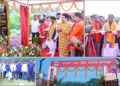
On Sunday morning at Seva Mahatirth in Badi, the sacred fire rose, and 50 couples walked around it. Some leaned on crutches. Some moved with artificial limbs. A few arrived in wheelchairs. All of them took the seven vows and began married life together.
Narayan Seva Sansthan’s 47th free mass wedding for persons with disabilities and the underprivileged closed a two-day ceremony that brought 100 brides and grooms from different states of India to Udaipur. It was not staged as charity theatre. It was a wedding — complete with turmeric, mehendi, music, Vedic chants and the quiet courage of people who have already rebuilt their lives once.
Yellow attire, yellow flowers, a campus in celebration
The ceremony began on Saturday with Ganesh Vandana. Then came the familiar warmth of Indian weddings: haldi and mehendi. Dressed in yellow, the 50 couples sat together on a stage decorated with yellow flowers. The colour filled the hall and, for a few hours, so did laughter.
That evening, a women’s musical and dance programme turned the campus festive. Performances based on Radha-Krishna Raas, Lord Hanuman, Goddess Durga and Lord Ram drew on the colours of Indian culture. Because the occasion coincided with Radha Ashtami, devotees sang to Radha and Krishna, and a flower Holi added play to the devotion.
On Sunday, the mood shifted from celebration to solemnity. Amid Vedic chants, the couples took seven vows around the sacred fire. Several pairs included one person with a disability and one without — partners who chose each other against the grain of social habit.

From patients to newlyweds
The most moving thread of the weekend was not the scale of the event. It was the circle that closed for many of the brides and grooms.
Several of them had first come to Narayan Seva Sansthan not for marriage, but for treatment: surgeries, artificial limbs, assistive devices and rehabilitation. They arrived as patients. They left the same campus hand in hand, as husband and wife. For them, the wedding was not only a social ceremony. It was the next chapter after recovery.
President Prashant Agarwal put the institution’s argument plainly. Persons with disabilities need respect, opportunity and a secure future — not sympathy. Society, he said, should look at ability and talent instead of reducing a person to disability. The presence of mixed couples, he added, showed people choosing partners beyond prevailing social perceptions.
Over the past 22 years, the Sansthan has facilitated the marriages of 2,582 young men and women with disabilities.
A household to begin with
The Sansthan did not stop at the mandap. Each newlywed couple received household essentials meant to turn vows into a working home: a bed, mattress, bedding, cupboard, gas stove and cylinder, kitchen set, fan, sewing machine and trolley bag, along with other daily-use items. Wheelchairs and other assistive devices were provided where needed.
The gift list is practical, almost stubbornly so. A sewing machine can become income. A gas stove can become a kitchen. A cupboard can become the first piece of a house. The message was the same as Agarwal’s speech: dignity needs tools, not pity.

Honours, guests and a look at the World of Humanity
During the ceremony, the Sansthan honoured service contributors, including former Indian Army Commander B.L. Bandhan from Agra and Rajesh Kanjani from Argentina. Founder-Chairman Padma Shri Kailash ‘Manav’, President Prashant Agarwal, Director Vandana Agarwal and Jagdish Arya presented them with turbans, ceremonial stoles and mementoes.
Sushila Parihar, from a freedom-fighter family in Jodhpur, was honoured for her spirit of compassion and service.
Among those present were Founder Kailash ‘Manav’, Co-founder Kamla Devi, President Prashant Agarwal, Director Vandana Agarwal, Palak Agarwal and Yash Mehta. Guests also visited the institution’s newly constructed World of Humanity complex and learned about its treatment, rehabilitation and service work.
What the vows were really about
Mass weddings can flatten people into numbers. This one resists that, if you look closely enough.
A young man who once came for an artificial limb now stands at a fire with a partner who chose him. A woman who learned to walk again leaves with a kitchen set and a new name for her future. Couples who ignore the old social script — disability on one side, “ability” on the other — make a public argument without making a speech.
Narayan Seva Sansthan has spent four decades arguing that rehabilitation is incomplete if it ends at the hospital gate. Surgery can restore movement. A limb can restore balance. Marriage, in this telling, restores belonging.
On Sunday in Badi, 50 couples finished the seven vows and stepped into family life. The flowers will fade. The fire will go out. The households, if the Sansthan’s wager is right, will not.