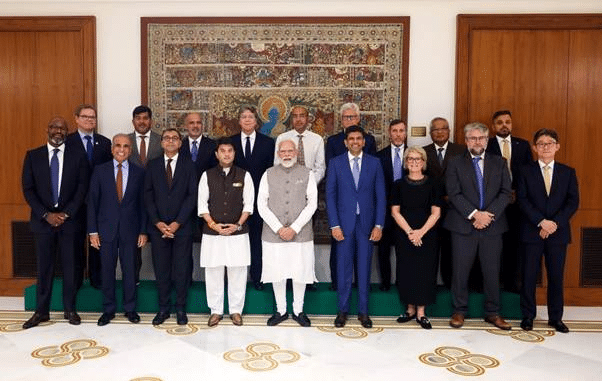
Prime Minister Narendra Modi met members of the Global System for Mobile Communications Association (GSMA) Board at Seva Teerth on 7 October 2026, setting the tone for the 10th India Mobile Congress that runs from 7 to 10 October at Yashobhoomi in New Delhi.
Union Minister for Communications Jyotiraditya Scindia and Minister of State Dr. Chandra Sekhar Pemmasani joined the interaction, which focused on how mobile technology can drive inclusive growth while managing the risks of rapid digital change.
Modi told the visiting executives that technology must serve as a tool for inclusive and sustainable development. He stressed the need to democratise access so that no section of society is left behind, particularly in the Global South. Making digital services affordable and extending them to the last mile, he said, is essential to prevent a widening digital divide. India’s experience with Digital Public Infrastructure was presented as a practical model that other developing economies could adapt.
The Prime Minister also called for common global standards and rules governing emerging technologies. On the rise of deepfakes and AI-generated content, he suggested exploring mechanisms that would allow users to quickly identify the origin of such material. Cyber fraud received equal attention: he advocated technology-driven safeguards and sustained public awareness campaigns to help people recognise fraudulent calls and scams.
GSMA Board members responded by recognising India’s rapid expansion of 4G and 5G networks, the scale of its digital public infrastructure, and the growth of its telecom and mobile manufacturing base. They noted the country’s investment-friendly policy environment and the importance of secure, resilient networks. The discussion identified concrete areas for deeper cooperation, including 5G and 6G development, artificial intelligence, cybersecurity, digital inclusion, and satellite connectivity.
The meeting comes as India hosts the 10th edition of the India Mobile Congress under the theme “Scale Without Boundaries.” Organised by the Department of Telecommunications and the Cellular Operators Association of India, the four-day event brings together operators, technology companies, policymakers, and startups to examine next-generation connectivity and its applications. Officials described the GSMA interaction as a signal of India’s growing role in shaping international conversations on trusted digital infrastructure and equitable access to advanced mobile technologies.