The Government of India has officially raised the bar for automotive fuel efficiency. The Ministry of Power has notified the new Corporate Average Fuel Economy (CAFE) norms for passenger vehicles, setting a clear, progressive roadmap for the next five years.
Effective from April 1, 2027, through March 31, 2032, these regulations apply to all new passenger vehicles manufactured or imported for sale across the country.
Tightening Benchmarks for a Greener Fleet
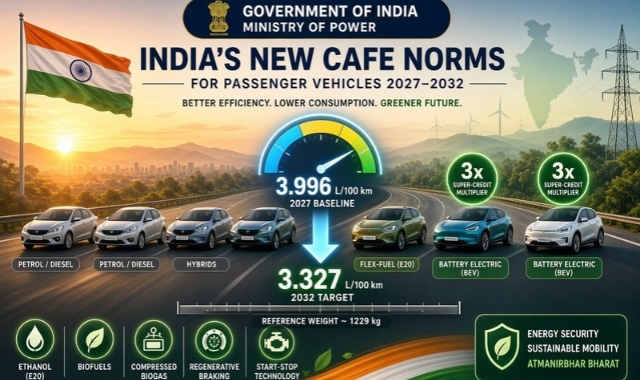
The newly minted framework introduces year-on-year tightening of targets to curb fossil-fuel consumption significantly. The baseline fuel-consumption benchmark is set to drop from 3.996 litres per 100 km in 2027–28 down to 3.3273 litres per 100 km by 2031–32. This progressive shift marks an impressive overall fuel-efficiency improvement of approximately 16.7 per cent.
To better match the evolving anatomy of India’s car market, the reference weight has been adjusted upward from 1,082 kg to 1,229 kg (a 13.6 per cent increase). This flattened target line offers a balanced, weight-sensitive approach—applying softer expectations for lighter vehicles while placing stricter fuel-efficiency demands on heavier models.
Flexibility Meets High Ambition
While the targets are rigorous, the framework provides carmakers with extensive compliance flexibility, technology neutrality, and multiple pathways to meet their obligations:
-
Super Credits & Incentives: Battery Electric Vehicles (BEVs), Range-Extended Electric Vehicles (REEVs), Plug-in Hybrid Electric Vehicles (PHEVs), Strong Hybrid Electric Vehicles (SHEVs), and Flex-Fuel Vehicles will benefit from volume derogation factors (“super credits”). For instance, Battery EVs receive a 3x multiplier in fleet-average calculations.
-
Carbon Neutrality Factor: The framework embraces alternative fuels like ethanol blends (E20 and above), biofuels, and Compressed Biogas (CBG), discounting declared tailpipe emissions through designated carbon-neutrality multipliers.
-
Expanded Tech Recognition: The list of approved fuel-saving technologies (such as start-stop systems, regenerative braking, and advanced glazing) has expanded from 4 to 12, allowing manufacturers to claim vital CO2 credits.
-
Credit Trading and Passbooks: Manufacturers can bank, trade, or buy compliance credits via a transparent passbook system and the Bureau of Energy Efficiency (BEE). Furthermore, compliance can be managed across flexible multi-year blocks.
Steering Toward Energy Security
Accounting for a major share of the nation’s transport energy demand, the passenger vehicle sector plays a central role in India’s long-term energy security. Aligned with Prime Minister Narendra Modi’s vision for sustainable mobility, these future-ready norms successfully balance environmental urgency with industry growth. By bridging traditional testing methods (MIDC) with globally harmonised procedures (WLTP) and exempting low-volume boutique manufacturers (under 1,000 units annually), India is laying down a robust, world-class foundation for the clean-mobility transition of tomorrow.