Odisha’s mining, metals, infrastructure and IT strengths moved to the centre of India’s free trade debate this week as 136 business leaders and stakeholders gathered in Bhubaneswar for Global RISE 2026.
The conversation was less about whether new trade deals exist and more about whether the state’s manufacturers and service firms can use them to climb the value chain.
The Bhubaneswar edition, held at Lemon Tree Premier on September 9, was the third stop in SMBConnect’s 15-city series, The Next Phase of India’s Growth. After Ahmedabad and Pune, the programme turned to a state whose industrial identity is still closely tied to minerals and metals, even as Bhubaneswar’s IT and services economy expands. The themes were familiar to the series — FTAs, exports, technology, manufacturing and market access — but the local question was specific: can Odisha convert resource strength into higher-value exports?
Sandipan Ray, Founder and Director of SMBConnect, framed the challenge directly.
When you look at Odisha, the strengths are already there. Mining, metals, infrastructure and a growing IT sector. The UK FTA is now in force, and the EU agreement is moving towards ratification. For Odisha, that can mean better access for higher-value metal products and new possibilities for IT and services as well. But the bigger question is, can our businesses use that access to move up the value chain and compete globally? An FTA opens the door. Businesses still have to walk through it.
That distinction — access versus readiness — ran through the day.
An industrial base looking beyond raw materials
Odisha’s mineral resources support a large metals and manufacturing ecosystem. Ports, rail links and industrial infrastructure determine how quickly goods can move to domestic buyers and overseas markets. Those assets were treated not as background but as the practical foundation of export strategy.
Dr. Sanjeev Mahapatra, Director of Anand Industrial Gases Pvt. Ltd. and Terra Block Machinery Pvt. Ltd., and Honorary Secretary of both the Association of Industrial Entrepreneurs, Bhubaneswar, and the Utkal Chamber of Commerce and Industry Limited, delivered the inaugural keynote: “Odisha’s Industrial Rise: Empowering MSMEs for Global Manufacturing & Export Leadership.” The address set the tone for a programme aimed at MSMEs rather than only large industry.
The manufacturing discussion continued in the panel “From Mines to Markets: Enabling Odisha’s Manufacturing & Industrial MSMEs to Compete Globally.” Moderated by Dr. Dindayal Swain, Professor, Author and Life Coach, the session brought together Kaushal Poddar, Managing Director of Orissa Plasto Pipes / Aadi Poly Extrusion & Moulding; Tapas Das, Managing Director of SK Engineers India Pvt. Ltd.; and Surya Prakash Ankarboina, Director of Spatech Engineering Pvt. Ltd. and Secretary of the Seafarers Association of Odisha. The panel examined what smaller firms need if they are to join larger supply networks, add value rather than ship commodities, and meet the quality and delivery standards of export markets.
FTAs, ports and the hard work after the headline
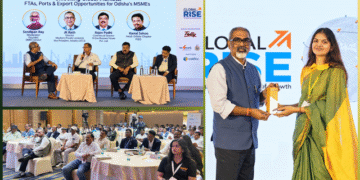
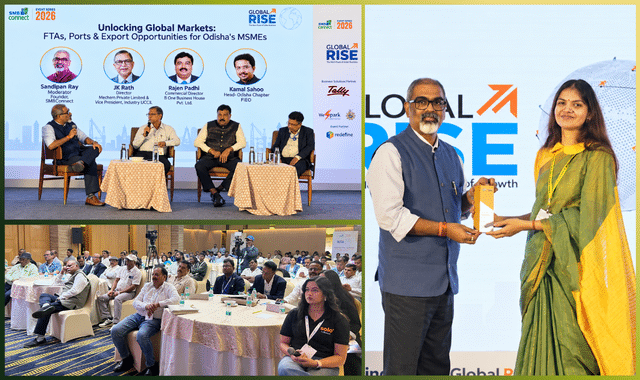
Policy was translated into business questions in “Unlocking Global Markets: FTAs, Ports & Export Opportunities for Odisha’s MSMEs.” Moderated by Ray, the conversation featured J.K. Rath, Director of Mechem Private Limited and Vice President – Industry at UCCIL; Rajen Padhi, Commercial Director of B One Business House Pvt. Ltd.; and Kamal Sahoo, Head of the Odisha Chapter of the Federation of Indian Export Organisations.
The discussion moved quickly past the existence of agreements to the decisions companies actually face: which products have export potential, where value addition improves competitiveness, how ports and logistics shape landed cost and reliability, and what capabilities a firm must already have before it enters a new market.
For manufacturing, the implied shift was from raw and semi-processed materials toward finished and higher-value metal and industrial products. For Bhubaneswar’s IT and services firms, India’s changing trade relationships were treated as relevant to services as well as goods. The recurring point was that an FTA can change the terms of access; it does not create competitive products, certified processes, pricing discipline, or market knowledge on its own.
Technology as an operating requirement
Technology and AI were presented as tools for competitiveness rather than as a separate digital agenda. Gautam Chakraborty, AGM – Product Excellence at Tally Solutions Private Limited, led “Building Future-Ready Businesses with Technology.” Kunal Koli, Manager at Interakt by Jio Haptik, followed with “Build Your AI Business Team in Minutes,” focusing on practical uses of AI inside everyday business functions.
The afternoon fireside chat, “The Intelligent Enterprise: How Odisha’s MSMEs Can Leverage AI, Digital Infrastructure & Smart Manufacturing for Global Growth,” took the same theme onto the shop floor and into the boardroom. Moderated by Padhi, it featured Pritam Pany, Partner at Artha Dhaara Corporate Advisory LLP, and Bhagaban Biswal, Managing Director of AECPL. The discussion considered how digital systems, AI, and smarter manufacturing processes can improve operations, decision-making, and the ability of MSMEs to scale without losing control.
Energy and operating costs were brought in through “Powering SMBs Growth with Tata Rooftop Solar,” with Gopal Krishna Dash, Managing Director of Parklands Solar Private Limited, and Ashok Kumar Mallick, Business Development Manager at Tata Power Solar Rooftop. Sustainability appeared here as a business input — power, cost and reliability — rather than as a standalone campaign.
A local ecosystem in the room
Nitisha Mann, IES, Joint Director, MSME-DFO, Cuttack, attended as Guest of Honour. Around the formal sessions, owners mixed with manufacturers, exporters, association leaders, technology providers, and other MSME stakeholders. The day closed with The Global RISE Awards 2026, recognising businesses and leaders from the enterprise ecosystem, followed by networking.
A 15-city argument, city by city
Global RISE 2026 is designed as a travelling argument rather than a single conference. Each edition looks at the same national themes — trade, exports, technology, manufacturing, finance and market access — through the industries that actually define that city. In Bhubaneswar, that meant mining, metals, ports and infrastructure, with IT as a second growth engine.
The series now moves on. After Bhubaneswar, the September calendar listed Patna on September 11, Coimbatore on September 23 and Hyderabad on September 25, with further editions scheduled through December 2026 across 12 more cities in total after the first three.
The organisers’ claim is modest and demanding at once. Trade agreements can open doors. Odisha already has minerals, metal-making capacity, ports and a rising services base. The unanswered work, as Ray put it, is whether businesses will walk through the door with products, processes and market readiness that can compete once they get there.
Global RISE 2026 is organised by SMBConnect, a 13-year-old business community and ecosystem platform that works with small and medium firms through conferences, industry engagement and access to networks and practical knowledge.