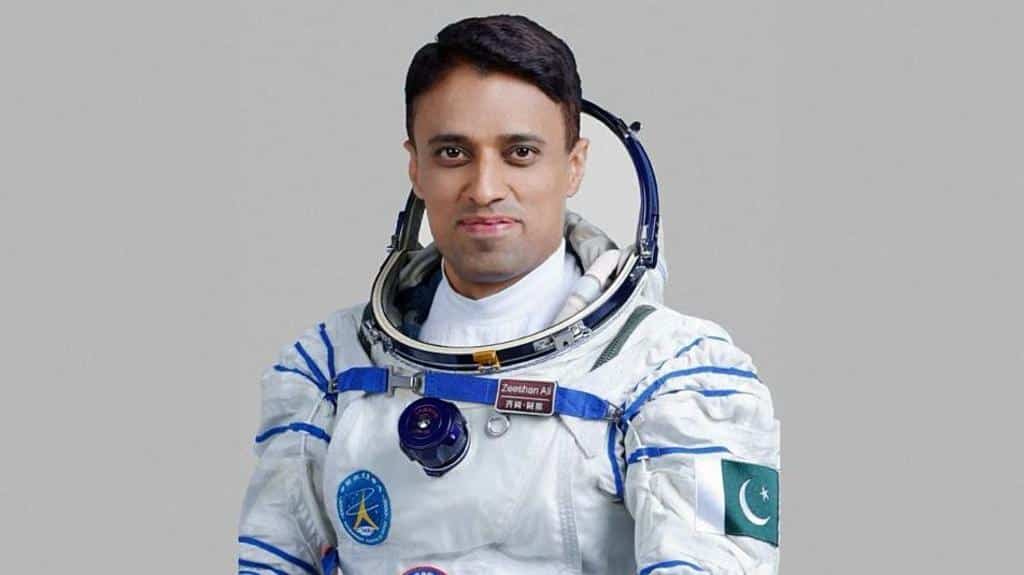
China on Wednesday, November 25, 2026, launched its Shenzhou-24 crewed spacecraft aboard a Long March 2F rocket from the Jiuquan Satellite Launch Centre in northwestern China’s Gobi Desert, sending Pakistani astronaut Muhammad Zeeshan Ali into orbit alongside two Chinese astronauts in the first-ever flight of a foreign astronaut on a Chinese crewed mission.
Lifting off at 8:18 AM local time, the three-member crew—comprising mission commander Tang Hongbo, flight engineer Wu Yi, and Pakistani payload specialist Muhammad Zeeshan Ali—is bound for China’s Tiangong space station. The flight marks Pakistan’s first human spaceflight milestone as well as Beijing’s opening of its orbital laboratory to international crew members.
Shenzhou-24 Mission Objectives & Tiangong Research
- 90 Scientific Experiments & Short-Duration Stay: According to the China Manned Space Agency (CMSA), the Shenzhou-24 mission involves around 90 scientific experiments and technology tests spanning space biology, space medicine, materials science, and microgravity physics. Ali, a 40-year-old Pakistan Air Force pilot, is slated to spend roughly a week aboard Tiangong conducting joint research before returning to Earth aboard the docked Shenzhou-23 spacecraft.
- Milestone for China’s Space Station Programme: Orbiting roughly 400 km above Earth, the three-module Tiangong space station serves as China’s permanent platform for long-term human spaceflight and scientific cooperation. Ahead of liftoff, Ali spoke in Mandarin at a pre-launch briefing, calling the mission a historic moment carrying the hopes of Pakistan.
Inside the Long March 2F Rocket & Its Safety Systems
Developed by the China Academy of Launch Vehicle Technology (CALT) under the China Aerospace Science and Technology Corporation (CASC), the 58.34-metre Long March 2F (CZ-2F) is China’s sole active human-rated launch vehicle. Powered by four liquid-fuel boosters and a core stage using YF-20B engines (burning UDMH and dinitrogen tetroxide) before a YF-24B-powered second stage places the spacecraft into orbit, it delivers over 8,100 kg of payload to low Earth orbit.
Equipped with a signature top-mounted launch escape tower designed to pull the crew capsule to safety in an emergency—and jettisoned roughly two minutes after liftoff—the Long March 2F debuted on November 20, 1999 (Shenzhou-1) and carried China’s first astronaut, Yang Liwei, into space on Shenzhou-5 in October 2003, making China the third nation after Russia and the United States to independently launch a human into orbit.