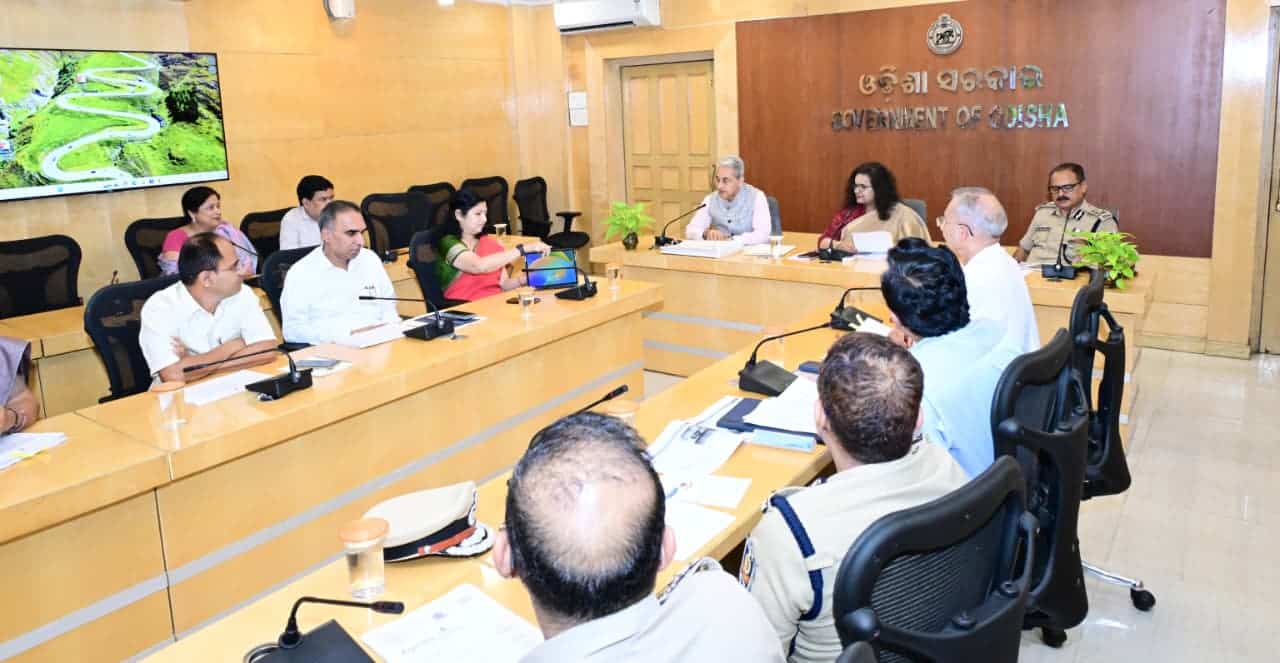
In a high-level review, Union Secretary of the Ministry of Social Justice and Empowerment (MoSJE) Sudhansh Pant held a detailed meeting with Odisha Chief Secretary Anu Garg today to assess the implementation of central and state welfare schemes for Scheduled Castes, Scheduled Tribes, minorities, backward classes, persons with disabilities, transgender persons and senior citizens.
The meeting underscored the shared commitment to inclusive development, with particular emphasis on the welfare of ST, SC, differently-abled and transgender communities. The Union Secretary appreciated Odisha’s various welfare initiatives and stressed the need for wider awareness under the Nasha Mukt Bharat Abhiyan.
Senior officials present included Director General of Police Binoytosh Mishra, Principal Secretary of the Social Security and Empowerment of Persons with Disabilities Department Suresh Kumar Vashishth, Director Parul Pattanaik, Commissioner-cum-Secretary of the SC, ST and MBC Department V. Parameswaran, Higher Education Commissioner-cum-Secretary Arvind Agrawal, School and Mass Education Secretary N. Tirumala Naik, along with other senior officers from the Home Department and concerned wings.
Commissioner-cum-Secretary V. Parameswaran presented the progress of various schemes aimed at the holistic development and empowerment of SC, ST, minority, and backward communities. Under the Pradhan Mantri Adarsh Gram Yojana (PMAGY), 2,033 villages across 30 districts have been selected for 2025-26 and 2026-27, of which 1,519 have already been declared Adarsh Grams, focusing on rural development, livelihoods and skill building.
The Income Generation Scheme (IGS) is empowering SC women self-help groups through bank loans and subsidies in agriculture, horticulture, animal husbandry, fisheries, industry, services and business. Under the Pradhan Mantri Anusuchit Jaati Abhyuday Yojana (PM-AJAY), 4,628 persons have received skill training and placement support. Odisha currently runs 168 SC hostels to improve educational access for students from remote areas. In 2025-26, post-matric scholarships were provided to 2,38,109 SC students and pre-matric scholarships to nearly one lakh students through the digital Odisha State Scholarship portal.
For students from backward classes, the PM Yashasvi scheme offers pre- and post-matric scholarships along with hostel facilities on a 60:40 centre-state funding pattern. In 2025-26 alone, 2,08,745 students received pre-matric and 4,71,572 received post-matric scholarships.
Success stories shared during the meeting included the Har Parbati SHG of Ganjam district excelling in orchid cultivation, Kishan Patra of Dhenkanal securing a technical job in Hyderabad, and Parshuram Majhi of Balasore finding employment in China’s technical sector. The Union Secretary praised these achievements and the overall performance of the departments while offering valuable suggestions.
Director of the Social Security and Empowerment of Persons with Disabilities Department presented updates on schemes for persons with disabilities, social security, transgender persons and senior citizens. For de-addiction, 41 Integrated Rehabilitation Centres and 11 “Disha” centres are operational. Through Disha centres, 4,986 persons have been rehabilitated, 3,577 given skill training and 1,459 provided livelihood-based employment.
Chief Secretary Anu Garg briefed on Odisha’s multi-pronged efforts under Nasha Mukt Odisha, including destruction of illegal cannabis cultivation, raids and extensive awareness programmes in schools and colleges. Secretary Pant emphasised expanding the reach of the Nasha Mukt Bharat Abhiyan.
On transgender welfare, the Odisha State Transgender Welfare Board has been constituted and held its first meeting on August 7. So far, 3,159 transgender certificates and identity cards have been issued. Beneficiaries receive support under the Madhubabu Pension scheme and housing under Basundhara. Over 104 transgender self-help groups have been formed, with 58 groups given a one-time assistance of ₹50,000 each. Twenty-one beggar rehabilitation centres are functioning across the state, assisting nearly 1,800 persons in eight districts.
For senior citizens, 95 old-age homes accommodate 2,600 inmates, with focus on healthcare and other support services.
The meeting also discussed long-term strategies aligned with the Viksit Odisha Vision 2036 and 2047. Emphasis was placed on revising the Senior Citizen Policy, formulating a Divyang Inclusive Policy, and establishing an Inter-Agency Council and State Resource Centre for the elderly and persons with disabilities. Updates were shared on the central sector scheme for beggars and the “Sahay” scheme for the rehabilitation of beggars and destitute persons.
The collaborative review reaffirmed the commitment of both the Centre and the Odisha government to ensure that the benefits of development reach the most vulnerable sections of society, building a more inclusive and empowered Odisha.