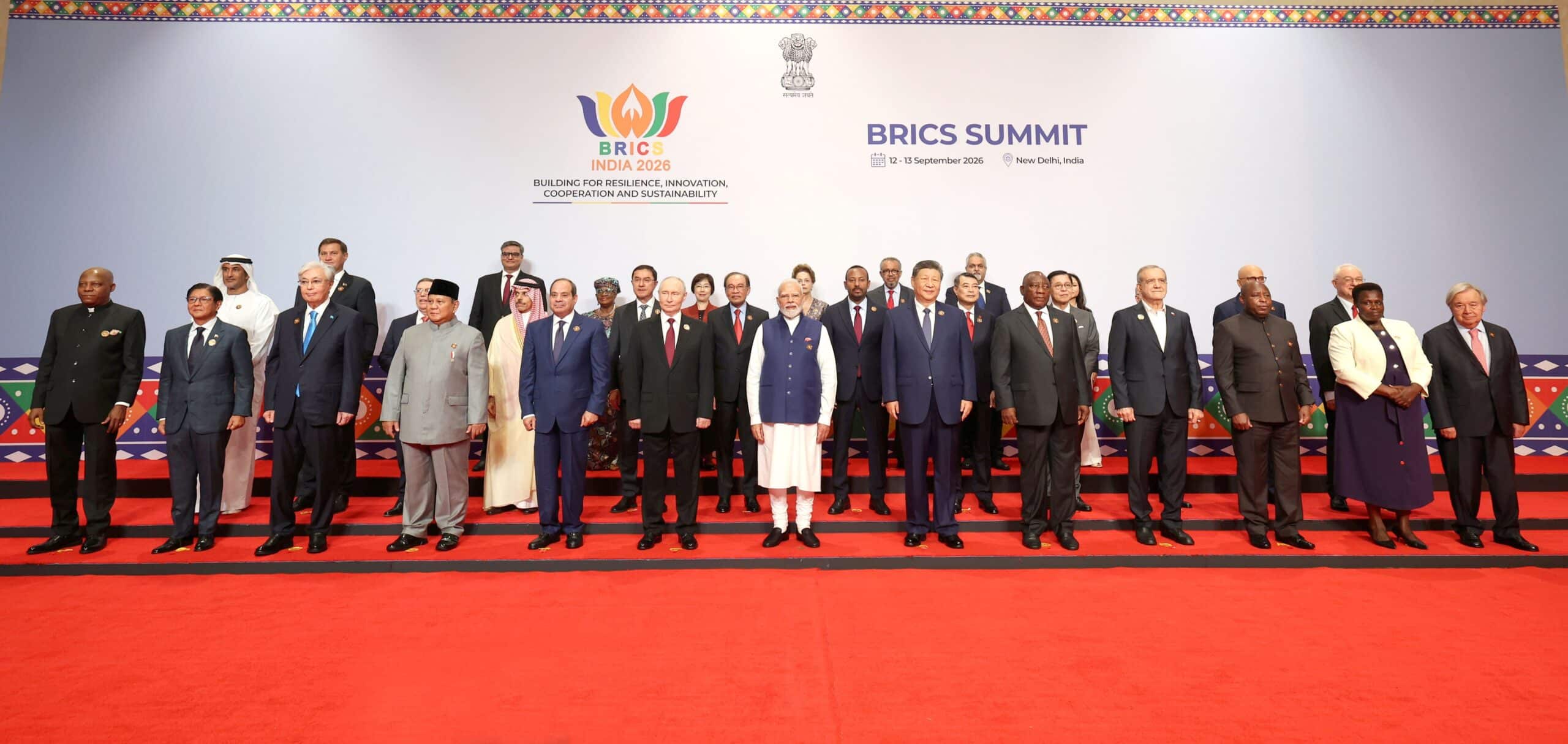
India’s hosting of the expanded BRICS summit in New Delhi emerged as a significant diplomatic moment, bringing together countries with competing geopolitical interests amid wars, economic uncertainty and growing tensions over the global order.
Speaking on Hindustan Times’ Point Blank, Executive Editor Shishir Gupta argued that the summit demonstrated India’s ability to bring powerful and often rival nations to the same table while maintaining relationships across competing geopolitical camps.
The discussions covered peace and security, technology, economic cooperation and the future role of the Global South.
BRICS becomes a wider diplomatic platform
The New Delhi summit was held against the backdrop of the Russia-Ukraine war, continuing instability in West Asia and disruptions affecting major maritime and energy routes.
The participation of countries such as Russia, China, Iran, the UAE, Saudi Arabia, Egypt, Ethiopia, Malaysia and Indonesia highlighted the increasingly diverse character of BRICS.
Several of these countries have significant differences with one another. Iran and Gulf Arab states, for instance, have long faced security and political tensions. Yet their participation in the same forum demonstrated the potential of BRICS as a space where differences can be managed without completely derailing broader cooperation.
Gupta compared BRICS’ growing role among non-Western powers with the G7’s role among Western economies, while stressing that BRICS is not a formal military or ideological alliance.
Instead, the grouping has increasingly become a platform for discussions on global governance, finance, technology, development and international security.
India-China ties remain a key test
One of the most closely watched developments was Chinese President Xi Jinping’s visit to India after a seven-year gap and his meeting with Prime Minister Narendra Modi.
The engagement generated expectations of an improvement in India-China relations, but the border remains the central test for any sustained thaw.
India has maintained that peace and tranquillity along the Line of Actual Control are essential for broader progress in bilateral relations. Past episodes, including the Chumar incident, the Doklam standoff and the 2020 eastern Ladakh tensions, have affected political trust between the two countries.
The latest diplomatic signals could therefore be important, but their long-term significance will depend on what follows the summit.
Sustained restraint along the border, stronger military communication and a reduction in incidents would be critical if the political engagement is to translate into a broader improvement in ties.
Gupta described India and China as competitors rather than inevitable military adversaries. That distinction leaves room for competition to be managed through diplomacy, communication and established mechanisms.
Can BRICS contribute to peace?
The summit also highlighted the potential role of BRICS in discussions around major conflicts.
On the Russia-Ukraine war, India has consistently advocated dialogue and a negotiated resolution while maintaining communication with both Moscow and Western partners.
BRICS alone cannot resolve the Ukraine conflict, given the complexity of territorial disputes, military calculations and wider tensions between Russia and the West. However, the presence of Russia, China and India within the same forum provides an additional channel for diplomatic messaging.
West Asia presents another major challenge.
The conflict and instability involving Iran, Israel, Gulf countries and other regional actors have implications far beyond the Middle East. Tensions around the Strait of Hormuz and Red Sea shipping routes can affect energy supplies, freight costs, insurance premiums and global trade.
For India, which relies heavily on imported energy and maritime commerce, stability in these routes has direct economic and strategic importance.
Iran-UAE engagement shows value of dialogue
The participation of Iran and the UAE in a common BRICS framework was another notable feature of the summit.
Despite their differing regional interests and security relationships, both countries participated in the wider diplomatic process.
The presence of Saudi Arabia also added significance, given Riyadh’s central role in Gulf security and energy markets.
The summit did not erase longstanding differences between these countries. But it demonstrated an important principle of diplomacy: rival nations do not necessarily need to resolve every dispute before they can engage on areas of common interest.
Keeping dialogue open can itself become a diplomatic achievement when geopolitical tensions are high.
India’s strategy of multi-alignment
Perhaps the biggest takeaway from the summit was India’s continued pursuit of strategic multi-alignment.
New Delhi maintains close ties with Russia and engages China through BRICS, while simultaneously deepening its defence, technology and economic partnerships with the United States and other Western countries.
India’s engagement with US aerospace and defence companies, including cooperation involving GE Aerospace and engines for the Tejas fighter programme, illustrates that participation in BRICS does not mean moving away from Washington.
Instead, India is attempting to preserve strategic autonomy by maintaining working relationships with multiple centres of power.
This approach allows New Delhi to expand its economic and technological options while avoiding an exclusive alignment with any single geopolitical bloc.
A diplomatic moment, not an immediate breakthrough
The New Delhi BRICS summit may not produce immediate breakthroughs on Ukraine, West Asia or India-China relations.
Its larger significance lies in India’s ability to convene countries that often disagree sharply, keep dialogue alive and push for a more representative international order.
In an increasingly fragmented world, New Delhi’s diplomatic message is clear: India does not see its foreign policy as a choice between competing blocs.
Instead, it is seeking the space to work with different powers on different issues while protecting its strategic autonomy and strengthening the voice of the Global South.