
For years, Raksha Bandhan advertising followed a familiar formula: a rakhi, a box of mithai, an emotional brother-sister moment and, inevitably, a message about protection and love.
But this year, brands seem to have realised that sibling relationships are far more complicated and far more entertaining than that.
On Raksha Bandhan 2026, brands are moving beyond the predictable rakhi-and-gifting narrative to explore siblinghood through humour, rivalry, emotional support, unexpected relationships and even financial planning. The result is a collection of campaigns that feel less like advertisements about a festival and more like observations about how people actually behave.
Haldiram’s, with ‘Keh Do Dil Ki Baat, Haldiram’s Ke Saath’, focuses on the things siblings rarely say to one another. The campaign finds affection in teasing, arguments, food-sharing and everyday gestures, suggesting that behind years of banter and fights are feelings that often remain unspoken. Mithai becomes the excuse to finally have those conversations.
Bakingo takes a completely different route with ‘Hisaab Barabar with Bakingo’, turning sibling scorekeeping into a game of Snakes and Ladders. Stealing food, borrowing clothes, fighting and keeping secrets become entries in an imaginary ledger. It is funny because it is familiar, almost every sibling relationship comes with a list of unresolved ‘hisaabs’.
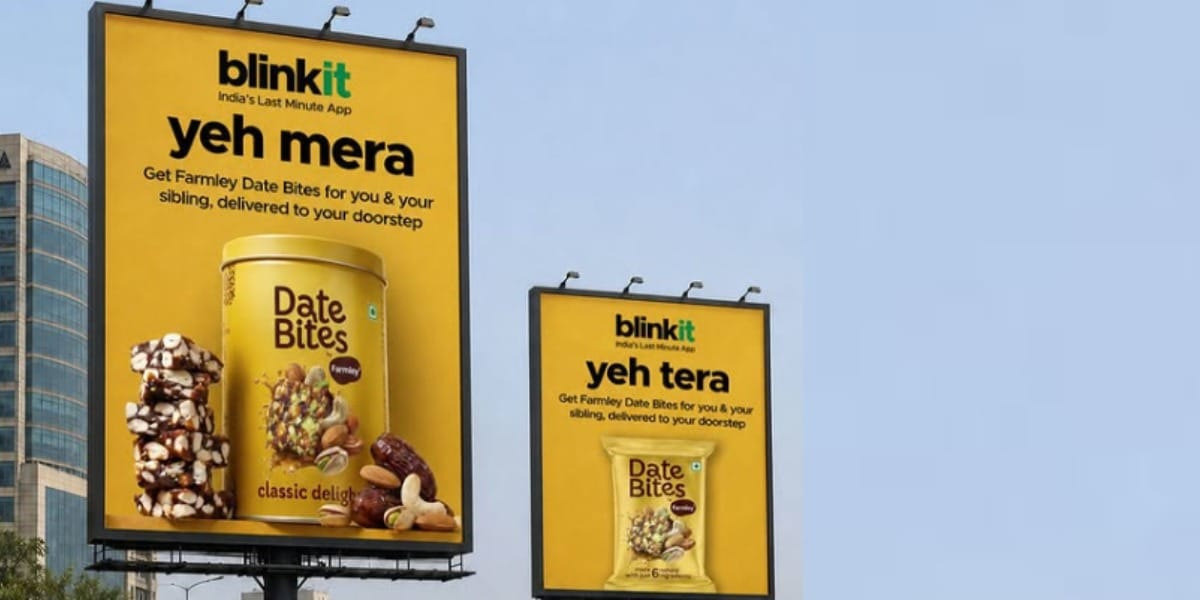
Farmley and Blinkit similarly tap into childhood rivalry with their OOH campaign for Farmley Date Bites. Built around the evergreen sibling argument of ‘yeh mera, yeh tera’, the campaign takes the fight over sharing food to billboards across Kanpur, Agra, Lucknow, Indore and Bhopal. It cleverly connects the emotional familiarity of traditional sibling banter with the convenience of quick-commerce gifting.
Zepto’s ‘Rigged Rakhi’, created with Cadbury Celebrations and GIVA, brings another twist by putting sisters in control. The campaign plays with the idea of changing the rules of the sibling game while tying the concept neatly to festive gifting.
Then comes perhaps the most unconventional interpretation. Top ‘N Town’s ‘Ankahe Rishte’, conceptualised by Meraqi Digital, moves beyond biological relationships altogether. The campaign follows a woman whose fear of a stray dog turns into trust after the animal protects her. She eventually ties a rakhi around its paw. In doing so, the campaign expands the idea of Raksha Bandhan from relationships defined by blood to bonds created through care and protection.
Tata Capital’s ‘#CountOnTheBond’, conceptualised by Schbang, takes a quieter approach. A brother helps his sister complete a pottery assignment by building a machine for her, while she supports him in his everyday life. The campaign celebrates the understated exchange of support that defines many sibling relationships.
Taken together, these campaigns point to an interesting shift in festive advertising. Brands are no longer simply selling the ritual of Raksha Bandhan; they are trying to capture the behaviour surrounding it.
The fights. The teasing. The competition. The sharing. The silent support. The unexpected protectors. The things left unsaid.
And perhaps that is where the strongest festive storytelling lies. Because people don’t celebrate the rakhi itself. They celebrate the relationship it represents, messy, funny, imperfect and, when it matters, always there.
✍️ About the Author
Sabyasachi Kundu is a former journalist with extensive experience in political and social reporting. He currently works as a Senior Communication Consultant, focusing on public discourse, governance, and citizen engagement. His writings often explore the intersection of policy, protest, and democratic accountability, drawing on years of newsroom and field experience.
The author can be contacted at mail@sabyasachi.work.
⚖️ Disclaimer
The views and opinions expressed in this article are solely those of the author and do not necessarily reflect the editorial stance of Pragativadi.com. Pragativadi remains committed to providing a platform for diverse perspectives while upholding its editorial independence and integrity.