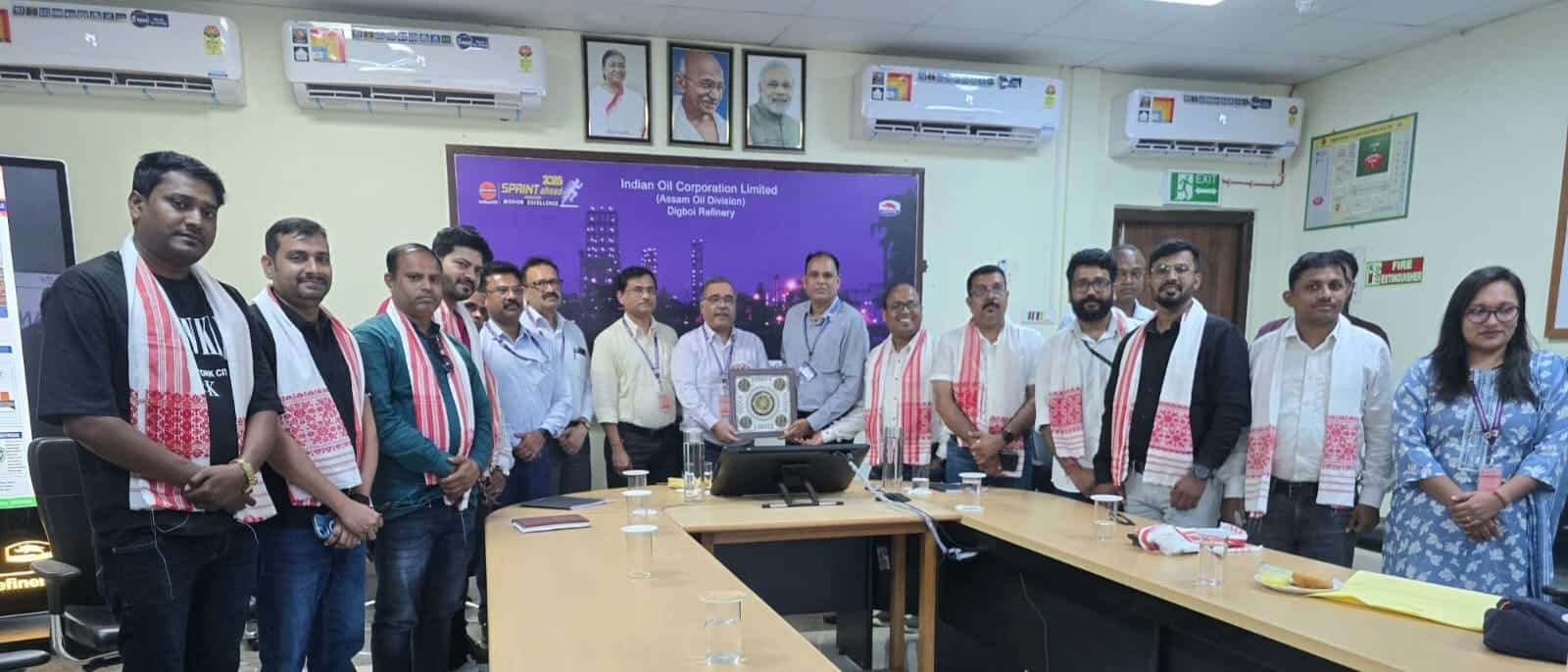
On the third day of their Assam tour, an Odisha media delegation led by the Press Information Bureau walked through Digboi Refinery, the plant often called the Gangotri of India’s hydrocarbon industry and Asia’s oldest continuously operating commercial oil refinery.
Indian Oil Corporation Limited (IOCL) is now pushing the historic site into a new scale. Annual capacity is being raised from 0.65 million metric tonnes per annum (MMTPA) to 1.0 MMTPA at an investment of about ₹740.20 crore. Prime Minister Narendra Modi laid the foundation for the expansion. New units are scheduled to come on stream by June–July 2027, timed to meet rising domestic demand for petroleum products.
Executive Director and Refinery Head Rahul Prashant and senior officials briefed the team on a story that begins in the late nineteenth century. Popular lore still credits an elephant named Rupkali, whose oil-stained footprints were said to have pointed to underground reserves. The first commercial well was drilled in 1889. The refinery itself started in 1901 with a modest 500 barrels a day. That unbroken run makes Digboi the world’s oldest continuously operating commercial refinery.
Today the complex houses a crude distillation unit, delayed coking unit and wax hydro-finishing unit. It is known worldwide for high-grade paraffin wax. It was also among the first Indian refineries to meet BS-VI fuel norms and has installed a reverse-osmosis plant aimed at zero liquid discharge.
Because the site sits inside a protected forest belt, environmental controls are tight. Roughly 80–85 percent of industrial water demand is met by harvested rainwater stored in a 28,000-cubic-metre reservoir. The facility has secured 72,96,012 rainwater offset units under an audited ESG water-credit framework. An effluent treatment plant of 400 cubic metres per hour, real-time CPCB/PCBA telemetry and five ambient air-quality stations run around the clock. About 54 percent of the complex remains under green cover.
IOCL placed Digboi in the wider company picture: ten refinery groups with combined capacity of 80.75 MMTPA, or about 31 percent of India’s total refining capacity. Parallel clean-energy work includes a 258 MW solar-and-wind portfolio, 15 hydrogen fuel-cell buses in Delhi-NCR, and a commercial-scale green hydrogen plant at Panipat Refinery powered entirely by renewable energy.
The visit closed at the Digboi Centenary Oil Museum and Discovery Well No. 1, where journalists saw a nineteenth-century cable-tool drilling rig, vintage equipment and early records of Indian oil exploration.
The delegation praised the refinery for keeping a living industrial heritage intact while setting contemporary standards in circular water use, responsible resource management and the shift toward cleaner energy. Digboi still stands as a bridge between the dawn of India’s petroleum age and a more sustainable energy future.