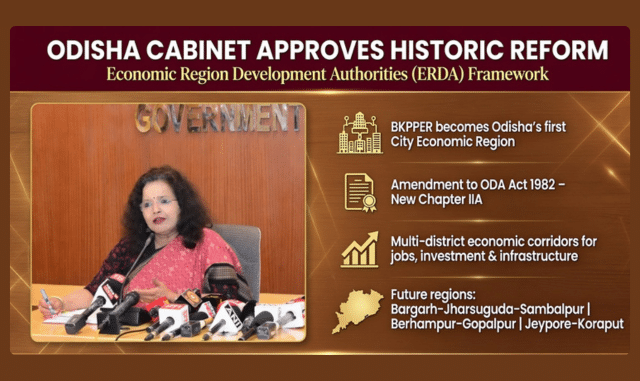
In a decisive push toward Viksit Odisha for Viksit Bharat, the 45th meeting of the Odisha Cabinet, chaired by Chief Minister Mohan Charan Majhi at Lok Seva Bhawan on Saturday, approved a landmark proposal from the Housing and Urban Development Department.
The Cabinet cleared the Odisha Development Authorities (Amendment) Bill, 2026, which will enable the creation of Economic Region Development Authorities (ERDAs) across the state.
The amendment to the Odisha Development Authorities Act, 1982, inserts new definitions for “Economic Region” and “Economic Region Development Authority” and adds a fresh Chapter IIA. This creates a durable, scalable statutory framework that allows the State Government to notify and constitute future ERDAs without needing fresh legislation each time.
Odisha’s Vision 2036 & 2047 identifies urbanisation as a major engine of economic growth. The plan calls for transforming city agglomerations into integrated economic corridors equipped with modern infrastructure, employment hubs, efficient mobility, and coordinated service delivery.
Key regions already identified include:
- Bhubaneswar–Cuttack–Puri–Paradeep Economic Region (BKPPER)
- Bargarh–Jharsuguda–Sambalpur
- Berhampur–Chhatrapur–Gopalpur
- Jeypore–Koraput–Sunabeda
An economic plan for BKPPER has already been prepared as a pilot in collaboration with NITI Aayog. Once the Bill is passed by the Odisha Legislative Assembly, BKPPER will be constituted as the state’s first City Economic Region (CER). The Union Budget 2026-27 has recognised only four such City Economic Regions in the entire country — BKPPER, Varanasi (Uttar Pradesh), Surat (Gujarat), and Visakhapatnam (Andhra Pradesh) — underscoring the national significance of Odisha’s initiative.
Chief Secretary Anu Garg highlighted that region-specific Economic Plans and Master Plans will allow planning beyond individual municipal boundaries. This will leverage the complementary strengths of constituent urban centres, attract investment, generate employment, and significantly improve housing, mobility, public services, and overall quality of life.
The new ERDAs will serve as overarching statutory authorities to ensure seamless coordination among existing Development Authorities within each economic region — a critical institutional missing link for multi-district corridors that integrate ports, industrial hubs, urban centres, religious and cultural sites, and logistics networks.
With this progressive reform, Odisha is positioning itself at the forefront of India’s next generation of economic geography — turning clusters of cities into powerful, cohesive engines of growth.