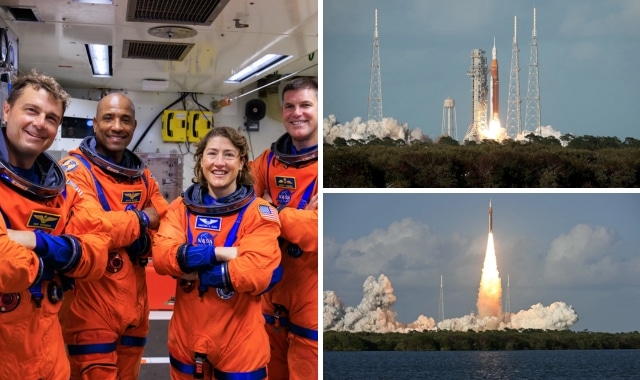
NASA launched four astronauts on the Artemis 2 mission, marking the first crewed voyage to the moon since Apollo 17 in 1972.
The Space Launch System rocket lifted off from Kennedy Space Centre on April 1 at 6:35 p.m. EDT, carrying the Orion spacecraft on a 10-day journey around the moon.
Commander Reid Wiseman, pilot Victor Glover, mission specialist Christina Koch, and Canadian astronaut Jeremy Hansen form the crew. Hansen becomes the first Canadian to fly into deep space. The astronauts will perform a lunar flyby, testing Orion’s systems and setting the stage for future moon landings.
NASA officials hailed the mission as a milestone in human space exploration. Artemis 2 represents the first time the SLS rocket and Orion capsule carry astronauts. The mission also includes historic firsts: the first woman, the first Black astronaut, and the first non-American to travel to the moon.
The spacecraft will travel farther from Earth than any humans in history, reaching 252,799 miles at its farthest point. The crew will test Orion’s life support, propulsion, and manual flight controls during the mission. NASA flight director Emily Nelson emphasised the importance of learning from Artemis 2 to prepare for more complex missions.
NASA Administrator Jared Isaacman outlined plans to accelerate Artemis missions, aiming for a moon landing by 2028 and a lunar base by 2032. Artemis 2 serves as a crucial step toward those goals, while also positioning NASA against global competitors in lunar exploration.