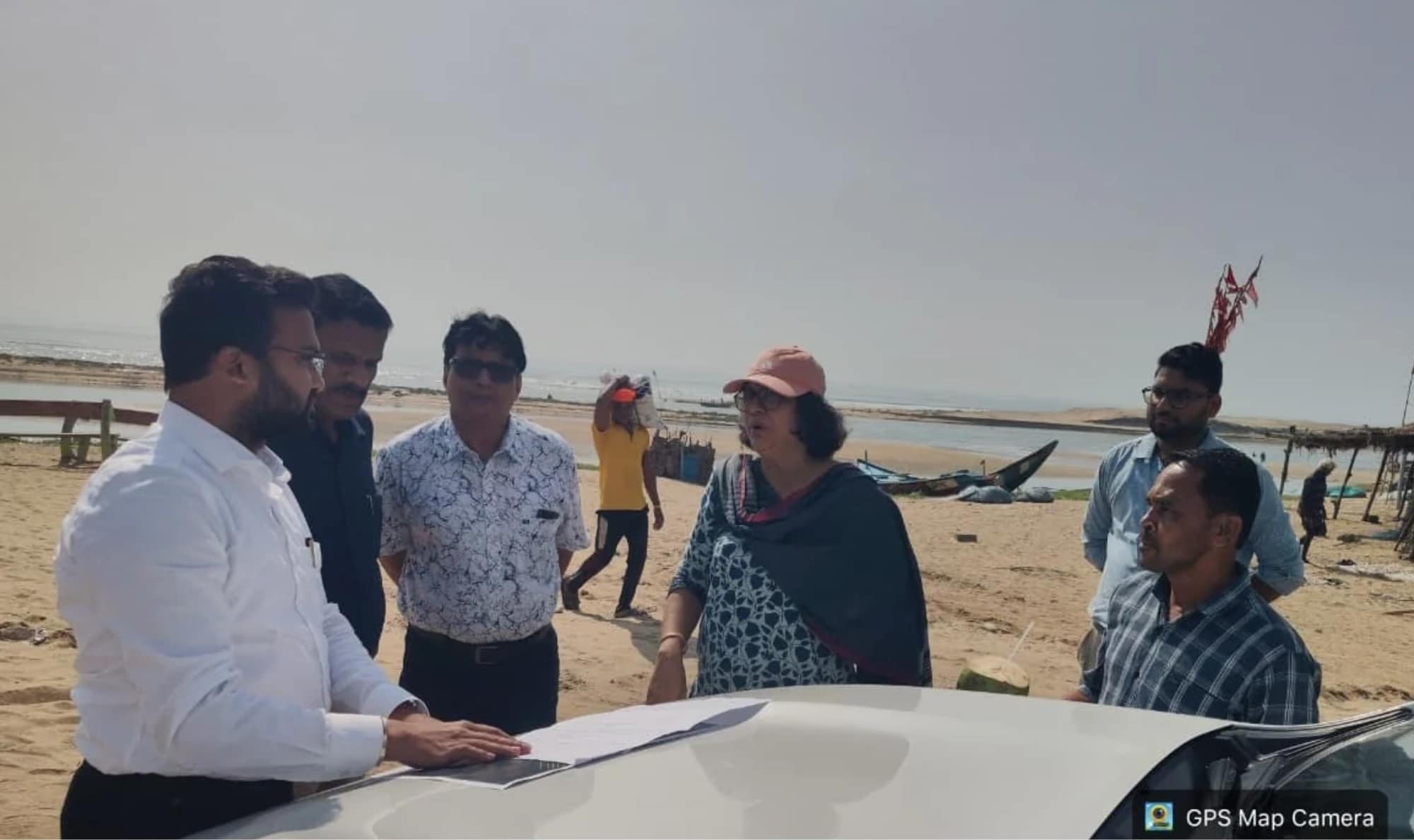
Accelerating government intervention in the aftermath of Cyclone ‘Arnab’, Shubha Sarma, Principal Secretary of the Department of Water Resources, conducted extensive field inspections across Ganjam district on the second day of her official visit.
The targeted review focused on evaluating the storm’s impact on major drainage channels and assessing structural readiness for flood management along critical coastal outfalls.
Accompanied by top engineering officials and regional basin teams, Smt. Sarma personally examined key watercourses to gauge discharge capacities and potential blockages caused by cyclone-induced heavy inflow.
Direct Field Assessment of Critical Outfalls
The inspection tour concentrated on high-priority drainage routes that carry surface runoff into the bay, including:
-
Bahana Nalla near Gopalpur NH Bridge: Evaluating channel clearance, siltation levels, and structural integrity near the National Highway corridor.
-
Markandi Outfall: Inspecting the mouth of Bahana Nalla to ensure unobstructed flow into coastal waters.
-
Haripur Outfall: Assessing the mouth of Bahada Nalla to prevent backwater ingress and regional inundation.
The on-site evaluations were aimed at restoring optimal drainage functionality and formulating immediate technical solutions for vulnerable low-lying areas.
High-Level Inter-Departmental Coordination
To ensure a comprehensive tactical strategy, the field visit brought together key technical leadership from across the state’s water management sectors. Senior personnel present included the Engineer-in-Chief (Water Resources), Chief Engineer (Drainage), and operational staff from the Drainage Division, Berhampur.
Additionally, specialised teams deployed in coordination with the Chief Engineer of the Rushikulya-Vansadhara Basin (RVBN) and Minor Irrigation (MI) participated in the assessment. The collaborative effort highlights a synchronised push to fortify Ganjam’s drainage network and secure local livelihoods against future weather disruptions.