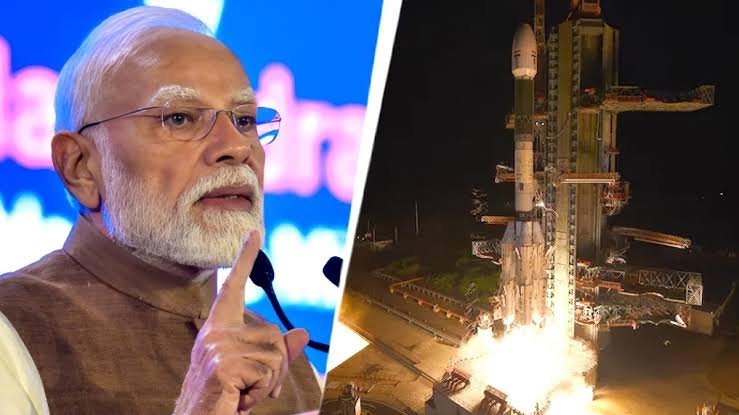
Prime Minister Narendra Modi on Saturday, October 31, 2026, commended scientists and engineers at the Indian Space Research Organisation (ISRO) following the successful launch of the GSLV-F18 mission carrying NVS-03, India’s next-generation navigation satellite.
The Geosynchronous Satellite Launch Vehicle (GSLV-F18) lifted off at 11:51 PM IST on Friday, October 30, from the Second Launch Pad at the Satish Dhawan Space Centre (SDSC-SHAR) in Sriharikota, Andhra Pradesh. The rocket successfully injected the 2,232-kg satellite into its intended Geosynchronous Transfer Orbit (GTO).
PM Modi Hails NavIC Augmentation
Lauding the space agency’s technical milestone, Prime Minister Modi highlighted the strategic importance of expanding India’s indigenous satellite navigation architecture:
”Congratulations to our scientists and engineers at ISRO on the successful launch of GSLV-F18 carrying NVS-03. Equipped with enhanced capabilities, NVS-03 will further our pursuit of self-reliance in critical technologies and support navigation services that benefit our people. The dedication and ingenuity of our space scientists continue to make our nation proud.”
The mission marks ISRO’s 20th flight of the GSLV launch vehicle and represents its third space launch of 2026.
Technical Capabilities & Strategic Importance
NVS-03 is the third satellite in the second-generation NVS series designed to reinforce Navigation with Indian Constellation (NavIC)—India’s independent regional satellite navigation network.
- Payload & Instrumentation: The satellite carries an indigenous atomic clock alongside secondary procured atomic clocks to ensure high-precision Position, Velocity, and Timing (PVT) calculations.
- Enhanced Frequency Band: In addition to legacy L5 and S-band signals, NVS-03 incorporates the civilian L1 navigation signal, enabling seamless integration with consumer devices and mobile handsets.
- Operational Coverage: NavIC provides high-accuracy regional positioning services across the Indian landmass and extends up to 1,500 km beyond national geopolitical boundaries.
- Orbital Positioning: Following deployment into GTO, onboard liquid propulsion systems will perform orbit-raising manoeuvres over the coming days to place the satellite into its designated geosynchronous position at 32.5 degrees East.
Following the successful orbital injection, ISRO confirmed that the satellite’s solar arrays deployed normally and initial health parameters remain optimal. The deployment lays the ground for upcoming launches of NVS-04 and NVS-05 to complete the second-generation constellation.