
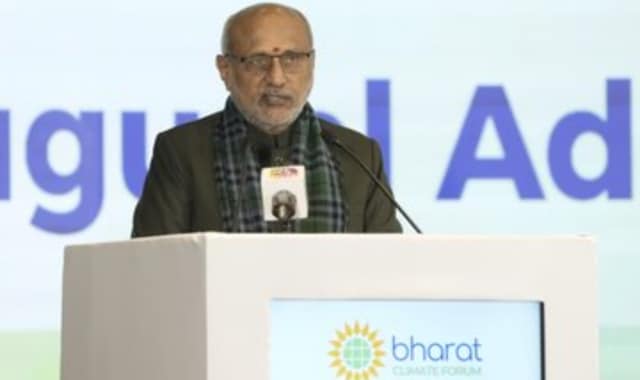
Vice-President of India C. P. Radhakrishnan delivered the inaugural address at the Bharat Climate Forum 2026, asserting that climate action is not a constraint but a strategic opportunity to accelerate inclusive growth, strengthen energy security, and build a future-ready economy.
Key Highlights from the Address
- Civilisational Ethos: He explained that India’s climate engagement draws strength from ancient traditions of harmony with nature. Moreover, he pointed to practices such as water conservation, sustainable agriculture, biodiversity preservation, and ethical principles like Prakriti and Aparigraha as timeless guides for sustainability.
- Balanced Development: Transitioning to India’s recent journey, the Vice-President highlighted that over the past decade, the nation has consistently balanced growth with equity, present needs with future responsibility. Furthermore, he noted that under Prime Minister Narendra Modi’s leadership, India has redefined how a developing nation approaches climate responsibility.
- Panchamrit Commitments: He recalled India’s pledges at COP-26, including achieving net-zero emissions by 2070. In addition, he emphasised that these commitments chart a clear pathway toward a low-carbon future while safeguarding development priorities.
- Homegrown Clean Tech: Moving to technology, the Vice-President stressed that India’s development must rely on indigenous clean technologies, resilient manufacturing, and a future-ready workforce. He cautioned that fragile imports cannot sustain a developed India.
- Global Leadership: He then underscored India’s leadership in the International Solar Alliance and the Coalition for Disaster Resilient Infrastructure, describing them as examples of India’s collaborative and forward-looking approach to climate partnerships.
The Vice-President further observed that Indian companies are investing heavily in solar modules, battery manufacturing, EV components, electrolysers, and green fuels. At the same time, start-ups are driving innovation in climate data, energy efficiency, and waste management. Consequently, he remarked, Make in India is transforming into Make in India for the World.
Finally, the Vice-President acknowledged the presence of key figures such as Shri N. K. Singh (Chairman), Smt. Meenakshi Lekhi (Convenor), Shri Sumant Sinha (Co-Chair), and Dr Ashwani Mahajan (President). Alongside them, policymakers, industry leaders, academics, and global stakeholders joined the forum, reinforcing its role as a national platform for serious reflection and purposeful action.