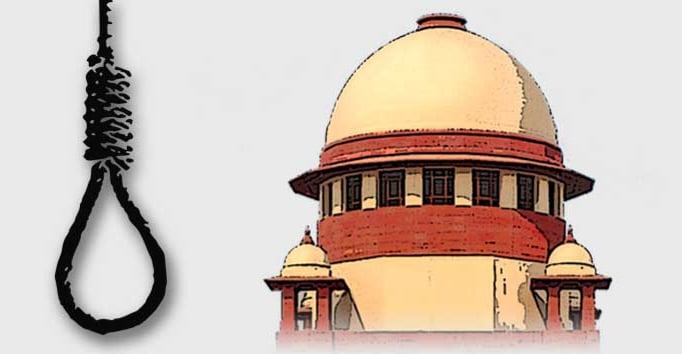
The Supreme Court on Tuesday declined to direct the government to replace hanging with another method of execution, but clarified that the existing practice can be reconsidered in light of future scientific and technological developments.
A bench of Justices Vikram Nath and Sandeep Mehta said there was no ground to revisit the Supreme Court’s 1983 Constitution Bench ruling in Deena @ Deena Dayal vs Union of India, which had upheld hanging as a constitutionally valid method of carrying out a death sentence.
However, the court stressed that its decision does not prevent future scrutiny of the method.
“The dismissal does not foreclose any future scrutiny based on scientific knowledge and subsequent developments,” the bench said while pronouncing its operative order.
Supreme Court leaves door open for alternative execution methods
The bench observed that the Union government remains free to review the existing method of execution and consider alternatives if future scientific or technological advances indicate that another method could reduce unnecessary pain while preserving the dignity of prisoners sentenced to death.
The court’s decision came in a petition filed by senior advocate Rishi Malhotra, who appeared in person and challenged the constitutional validity of execution by hanging.
Malhotra had challenged Section 354(5) of the Code of Criminal Procedure, whose corresponding provision is now Section 393(5) of the Bharatiya Nagarik Suraksha Sanhita, 2023. The provision requires a death sentence to be carried out by hanging.
Plea argued hanging violates Article 21
Malhotra argued that hanging is an outdated and painful form of execution and violates the right to life with dignity guaranteed under Article 21 of the Constitution.
He had asked the Supreme Court either to strike down or read down the statutory provision and permit a more humane alternative. He had also suggested giving condemned prisoners a choice regarding the method of execution.
The matter has been pending before the Supreme Court since 2017.
Centre had examined alternative methods
During the proceedings, the Union government informed the court that alternative methods of execution were being examined by a committee constituted for the purpose.
When the case was heard in January, the bench had questioned whether determining a less painful method of execution fell within the role of a constitutional court.
The judges had also considered whether the judiciary could direct the executive to change a method of execution specifically prescribed by law.
The court took note of the psychological impact executions can have on officials responsible for carrying them out and others who may witness them.
Centre says hanging is safest and quickest
The Union government had maintained that hanging remains the “safest and quickest” method of execution.
It opposed lethal injection as an alternative, pointing to reports of botched executions in the United States and concerns over the involvement of medical professionals in carrying out executions.
While the Supreme Court has therefore not ordered a change in the method of execution, its judgment leaves open the possibility of a future review if scientific evidence or technological developments establish a less painful alternative.