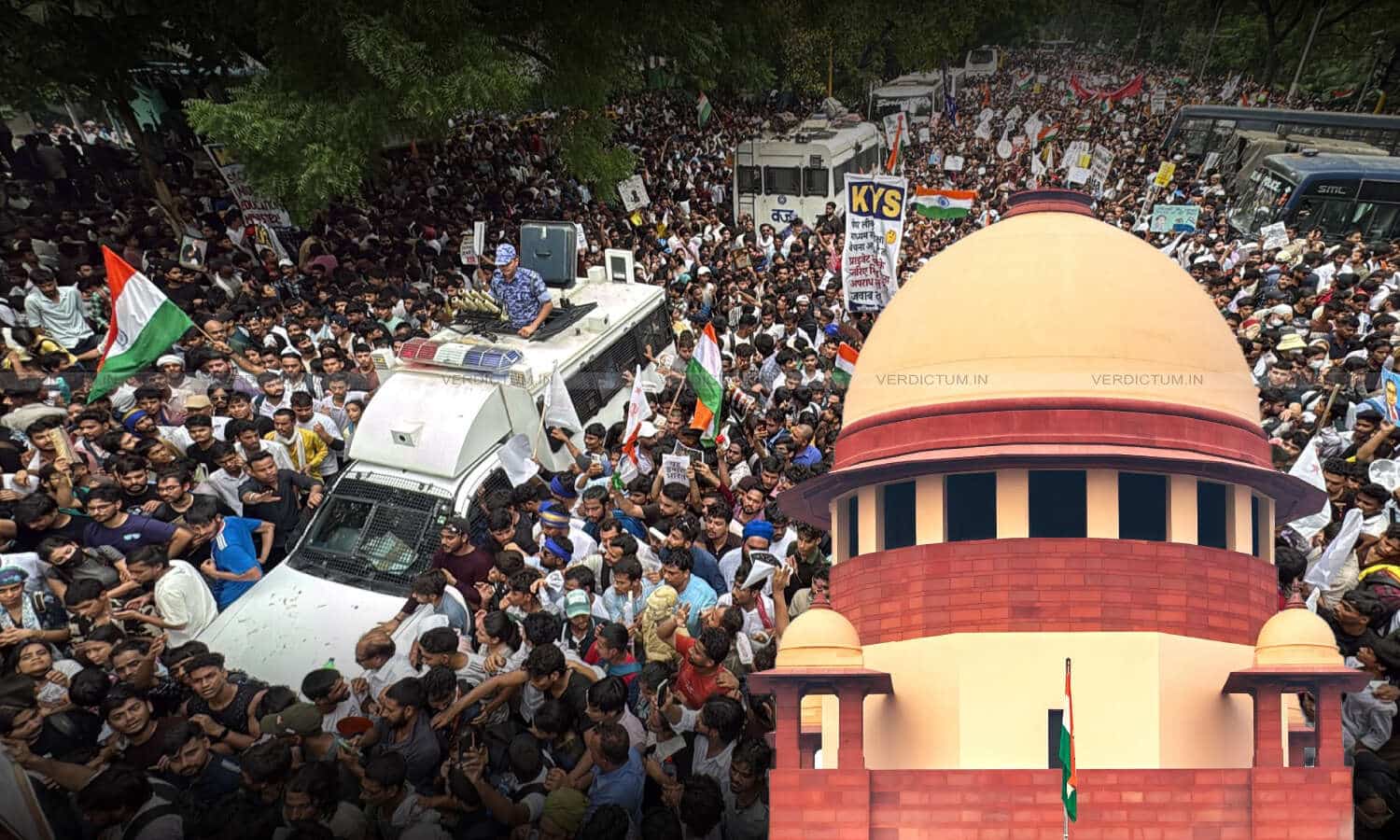
The Supreme Court on Tuesday directed all states to immediately release students below the age of 18 who were arrested during recent protests over examination irregularities.
The court also extended interim protection to protesters without criminal antecedents, while making it clear that the relief would not apply to individuals with criminal records or those involved in unlawful activities.
A Bench comprising Chief Justice of India Surya Kant, Justice Joymalya Bagchi and Justice V. Mohana passed the interim directions while hearing a batch of petitions alleging excessive police force during protests held in Delhi and several other states.
Court Calls for Independent Probe
Observing that the allegations warranted serious examination, the Supreme Court said both claims of police excesses and violence against police personnel required a “thorough, fair and impartial” independent investigation.
The Bench issued notices to the Union Government and the governments of Delhi, Maharashtra, Bihar, Assam, Kerala, West Bengal, Madhya Pradesh and Uttar Pradesh, seeking their responses.
The court observed that the material placed before it made out a prima facie case for an independent inquiry, which should also investigate complaints made by families of injured police personnel.
Peaceful Protest Is a Constitutional Right
During the hearing, the Bench reiterated that peaceful protests are protected under the Constitution.
“It was completely a peaceful protest by students raising demands. Such a protest is permissible and protected under the Constitution,” the court observed.
At the same time, it cautioned that peaceful demonstrations could be infiltrated by individuals with disruptive intentions, making an impartial investigation necessary.
Court Examines Allegations of Excessive Force
The Supreme Court took note of allegations involving:
- Use of pellet guns
- Electric batons
- Lathi-charge
- Assault on women protesters
- Assault on media personnel
- Participation of plainclothes police personnel in crowd-control operations
The Bench observed that allegations regarding the use of pellet guns resulting in serious injuries deserved careful examination.
Simultaneously, it acknowledged submissions that more than 200 police personnel were also reportedly injured during the protests.
Centre Supports Independent Investigation
Solicitor General Tushar Mehta, appearing for the Union Government and Delhi Police, informed the court that the Centre had no objection to an independent investigation.
He submitted that if students had suffered due to unlawful actions, those responsible should be held accountable, while also requesting that attacks on police personnel be investigated.
The court agreed that both aspects required an evidence-based inquiry rather than premature conclusions.
High-Powered Committee Under Consideration
The Bench indicated that it is considering constituting a high-powered committee to investigate incidents of violence beyond Delhi.
It also observed that existing judicial guidelines governing police handling of protests may require updating to address evolving circumstances, including the use of tear gas and other crowd-control measures.
Interim Directions Issued
As part of its interim order, the Supreme Court directed authorities to:
- Immediately release arrested protesters below 18 years of age.
- Extend interim protection to protesters without criminal antecedents.
- Preserve CCTV footage, drone recordings, body-camera footage, wireless communication records and PCR call logs related to the protests.
- Preserve digital evidence collected during the investigation.
- Refrain from publicly disclosing the personal information of protesters.
The Bench clarified that these protections will not apply to anti-social elements or persons with criminal backgrounds.
The matter is scheduled to be heard again next Monday, when the Centre and the concerned states are expected to file their responses.