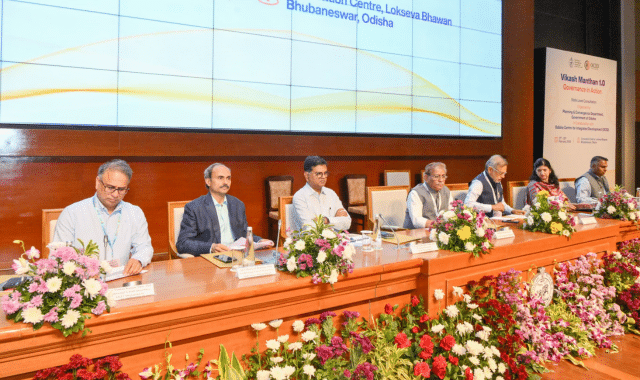
The fourth plenary session of Vikash Manthan 1.0 – Consultation: Governance in Action, titled Samruddha Odisha, convened senior officers to deliberate on strategies for propelling the state’s economy to new heights.
The wide-ranging discussions highlighted Odisha’s strong fiscal fundamentals, sectoral diversification opportunities, and the urgent need for time-bound execution across industry, services, urban development, logistics, and rural economies.
Moderated by Prof. Kshiti Bhusan Das with Rajiv Shekhar Sahoo as co-moderator, the session reflected collective optimism about Odisha’s trajectory while stressing coordinated action to realise the goals of *Viksit Odisha 2036* and *Viksit Bharat 2047*.
Hemant Sharma, IAS, Additional Chief Secretary, Industries Department, noted that industry currently contributes about 42% to the state’s economy and holds immense potential for further expansion. He advocated a calibrated transition from a mining-led model to value-added sectors like metallurgy, petrochemicals, and coastal chemicals, leveraging Odisha’s strategic coastline. Food processing and textiles were flagged as sunrise sectors, while green energy equipment and semiconductors show early promise for broadening the industrial base and boosting employment.
Vishal Kumar Dev, IAS, Additional Chief Secretary, Electronics & IT Department, highlighted Odisha’s robust macro-fiscal health—including revenue surplus and a prudent debt-GSDP ratio—creating room for strategic investments. With the services sector lagging the national average, he identified it as a major growth corridor. Odisha’s IT ecosystem now hosts around 350 companies, supported by progressive policies in IT, semiconductors, and India’s first dedicated AI framework. The state targets over 100 Global Capability Centres in sectors like BFSI, healthcare, retail, and manufacturing. Low attrition rates underscore the quality of its workforce. Emphasising inclusive growth, he called for democratizing AI, including training models on Odia language datasets, to transition Odisha from a “mine-driven” to a “mind-driven” economy.
Usha Padhee, IAS, Additional Chief Secretary, Housing & Urban Development Department, urged proactive urban planning as Odisha’s urbanisation stands at just 17%. She advocated shifting from isolated city development to integrated economic regions, citing global best practices. Key initiatives include the upcoming Livable City Mission for enhanced livability, seamless mobility, and integrated infrastructure. She spotlighted the BCPPER (Bhubaneswar–Cuttack–Puri–Paradeep Economic Region), projected to contribute one-third of the state’s GDP.
Sanjay Kumar Singh, IAS, Principal Secretary, Works Department, positioned road infrastructure as the bedrock of growth across industries, tourism, rural areas, and logistics. Industries prefer roads for freight up to 600 km, yet Odisha trails the national average in road density and six-lane National Highways. The government aims to leapfrog into the top ten states for road density through data-driven planning, new economic corridors, and capacity enhancements to fortify the logistics backbone.
Girish S.N., IAS, Commissioner-cum-Secretary, Panchayati Raj & Drinking Water Department, presented a holistic rural transformation strategy centred on non-farm jobs, model villages, Gram Panchayat empowerment, and last-mile connectivity. Plans include micro-skilling hubs in all 314 blocks, transforming SHGs into SMEs, high-skill rural clusters to reduce migration, saturation of basic amenities via the Model Village Mission, and performance-linked Gram Panchayat Development Plans. The Mukhya Mantri Sadak Yojana targets connecting 2,601 unconnected habitations with 6,505 km of roads at an estimated ₹7,800 crore investment, fostering dignified livelihoods and balanced regional development.
The deliberations underscored Odisha’s readiness—bolstered by fiscal strength, policy reforms, and infrastructure momentum—to diversify, innovate, and execute decisively for inclusive, sustainable prosperity.