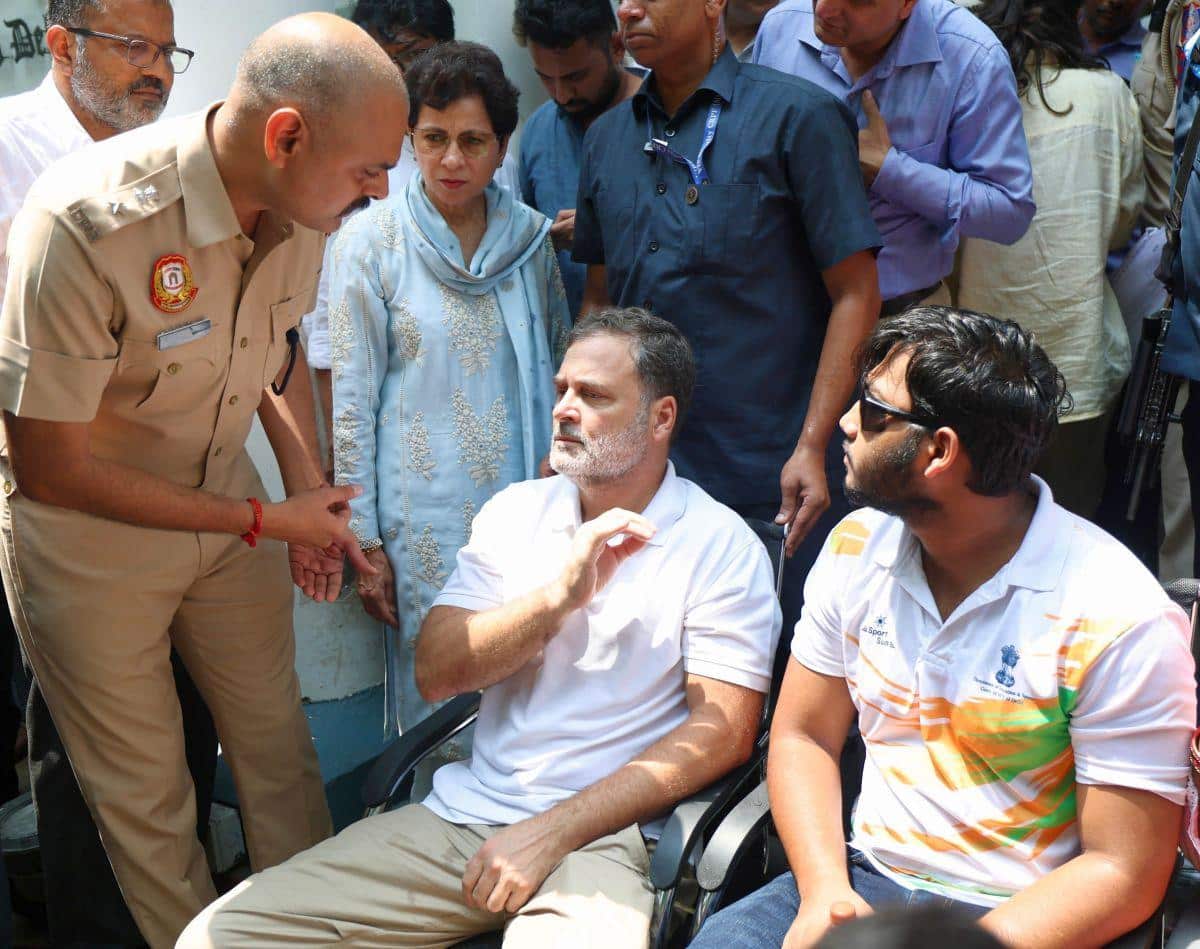
In a dramatic escalation of the ongoing row over alleged police brutality against student protesters, Leader of Opposition in the Lok Sabha Rahul Gandhi staged a sit-in (dharna) outside the Deputy Commissioner of Police (DCP) office at the Parliament Street Police Station in New Delhi on Friday.
Gandhi was accompanied by 19-year-old student Sahil Lochab and his mother. Lochab allegedly suffered severe eye and abdominal injuries from pellet-gun fire during a protest at Jantar Mantar on July 20, which was held to demand education reforms.
Refusal to File FIR Triggers High-Voltage Protest
According to the Congress party, Lochab had submitted a formal complaint to the Delhi Police on August 14, followed by multiple reminders. However, authorities allegedly refused to issue an Investigation Officer (I/O) number or register an First Information Report (FIR).
Gandhi initially visited the Mandir Marg Police Station before heading to Parliament Street to meet Central Delhi DCP Sachin Sharma. After direct talks with senior police officials failed to secure the registration of a case, the Congress leader sat on the ground outside the station in protest.
”Today, I went to the DCP office at Parliament Street to file an FIR against the police brutality faced by Sahil Lochab,” Gandhi stated on X. “On July 20, the police attacked Sahil, who was peacefully protesting… with a pellet gun. Severely injured by the pellets, Sahil’s vision in one eye is now at risk. When Sahil wants to file an FIR for justice, even that is not being allowed. In this way, the Constitution and constitutional rights are being trampled upon”.
Mounting Pressure and Judicial Intervention
The standoff comes on the heels of major political friction surrounding the July 20 demonstrations. While official confirmation regarding the widespread deployment of pellet guns remains sparse, internal police daily diary entries cited by reports indicate that Rapid Action Force (RAF) personnel fired anti-riot guns loaded with plastic pellets during crowd-control efforts.
In response to petitioning regarding police excesses—including allegations of pellet gun usage, electric batons, and lathi charges—the Supreme Court of India constituted a five-member high-powered enquiry committee headed by former judge Justice R. Subhash Reddy to investigate the actions taken during the protests.