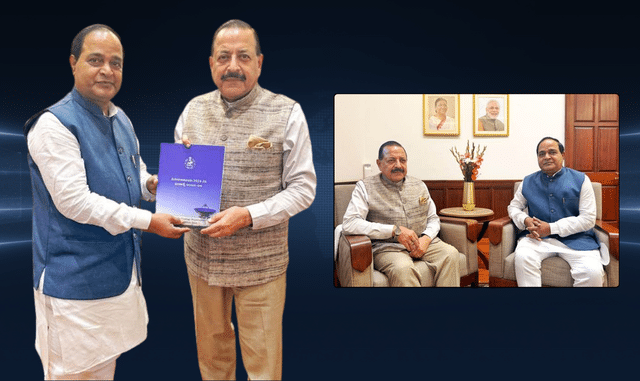
Dr. Jitendra Singh was discussing the roadmap with Odisha’s Cabinet Minister for Science & Technology, Krushna Chandra Patra, who called on him and presented a series of proposals relating to the State’s science and technology priorities. The discussions covered the expansion of marine biotechnology, strengthening of life sciences infrastructure, greater utilisation of Odisha’s coastal and mineral resources, space applications and manufacturing, Rare Earth exploration, scientific infrastructure and participation of coastal districts in national marine-environment initiatives.
The meeting finalised expansion of “Institute of Life Sciences”, Bhubaneswar belonging to the Department of Biotechnology, Govt of India, with provision for additional 50 acres land from the Odisha State Government.
Dr Jitendra Singh said the Eastern Coastal Region can play a much larger role in India’s emerging Nuclear and Marine roadmap, with Odisha well placed to contribute through coordinated efforts involving Central scientific institutions and the State Government. The approach seeks to move from individual institutional initiatives towards a connected ecosystem spanning ocean resources, critical minerals, life sciences, space technology and technology-led economic development.
A key component of the discussions was the Odisha Marine Biotechnology Research & Innovation Corridor (OMBRIC), which is being developed as a collaborative platform bringing together leading academic and research institutions in the State. OMBRIC has already established partnerships with IIT Bhubaneswar, Berhampur University, Fakir Mohan University, NIT Rourkela, IISER Berhampur and the Institute of Life Sciences (ILS), Bhubaneswar. The next phase will seek to align this institutional network more closely with Earth Sciences, CSIR and the Department of Biotechnology, enabling Odisha’s marine resources to be connected with advanced research, biotechnology applications and industrial innovation.
The meeting also took forward the expansion of the “Institute of Life Sciences”, Bhubaneswar belonging to the Department of Biotechnology, Govt of India, with provision for an additional 50 acres of land from the State Government to support its future growth. The expanded institutional capacity can provide a stronger base for research in life sciences and biotechnology and for initiatives linked to the Bio-E3 framework, Biotechnology for Economy, Environment and Employment. This assumes particular significance for Odisha, given its extensive coastline, marine biodiversity and resource base. The State’s marine ecosystem can provide opportunities for biotechnology applications across areas such as bio-resources, health, food, materials and environmental solutions.
The proposed convergence between marine biotechnology and Earth Sciences is also intended to strengthen the scientific understanding and sustainable utilisation of Odisha’s coastal resources. The approach will bring together expertise in marine science, earth sciences, biotechnology and mineral-resource research, creating greater scope for joint projects and technology development.
The Space Applications Centre in Odisha was another important part of the discussions. The meeting explored closer alignment of the State’s space capabilities with ISRO, including the possibility of developing a Space Research and Manufacturing Centre in PPP mode. Such an ecosystem can bring together government institutions, national space agencies, research organisations and industry, creating opportunities not only for space applications but also for research, technology development and manufacturing.
The discussions also covered Odisha’s role in the emerging Rare Earth ecosystem. The Union Budget 2026–27 has announced dedicated Rare Earth Corridors in Odisha, Kerala, Andhra Pradesh and Tamil Nadu, with a focus on mining, processing, research and manufacturing. The initiative is intended to build an integrated domestic value chain for rare earths and strengthen India’s capabilities in advanced materials and strategic sectors.
In this context, Odisha’s coastal mineral resources and its existing scientific and institutional capabilities provide a strong foundation for further exploration and technology development. The meeting discussed taking forward work relating to rare earth exploration and associated scientific capabilities, while connecting these efforts with the larger national priorities in atomic minerals, advanced materials and strategic technologies. Odisha already has an important presence in the rare-earth ecosystem, including facilities associated with India’s rare-earth processing activities.
The Deep Ocean Mission and the emerging opportunities in deep-sea fisheries also formed part of the broader coastal development agenda. Odisha’s long coastline and marine resource base provide significant scope for integrating ocean science, fisheries, marine technology and coastal economic activity. The State has recently taken forward its Odisha Deep Sea Fishing Mission (2026–2036), aimed at unlocking offshore and deep-sea fisheries potential and developing stronger value chains around the marine economy.
The proposed Science City in Odisha was also discussed as an important public-facing component of the State’s expanding science and technology ecosystem. The initiative can provide a platform for scientific awareness, innovation, experiential learning and greater engagement of young people with science and technology, complementing the research infrastructure being developed across the State.
The discussions further covered the possibility of leveraging Odisha’s strong cluster of Central and national scientific institutions for collaborative projects. Greater coordination among institutions working in marine sciences, earth sciences, biotechnology, critical minerals and space applications can help create a more integrated research and innovation ecosystem in the State.
The meeting also included Odisha’s participation in the forthcoming ‘Swachh Sagar, Surakshit Sagar’ campaign. With several coastal districts of the State participating in the initiative, coordination with district administrations will be strengthened to facilitate public participation, coastal cleanliness activities and wider awareness about protection of the marine environment.
Dr. Singh and Minister Patra agreed on the importance of continued Centre-State coordination for taking these initiatives forward. The proposed convergence of marine resources, biotechnology, critical minerals, space technology, and scientific infrastructure provides Odisha an opportunity to build a distinctive science-led development model for the Eastern Coastal Region, while contributing to India’s wider objectives of technological self-reliance and sustainable utilisation of its natural resources.