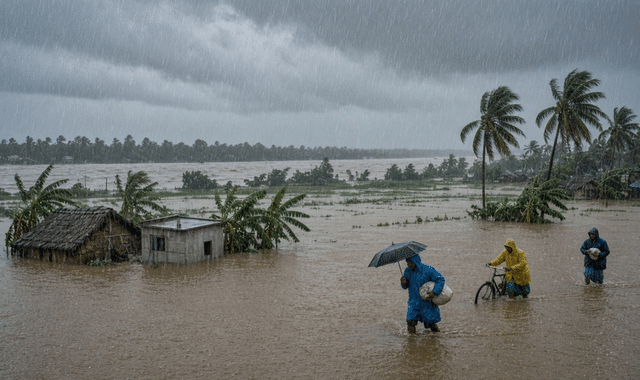
The monsoon has already given Odisha more than it usually receives in four months. The clouds, however, are not done with the north.
By August 31, the state had recorded 1,154.3 mm of southwest monsoon rainfall against a June–September normal of 1,150.2 mm. The seasonal quota was filled a full month early.
IMD Director General Dr Mrutyunjay Mohapatra, speaking to regional media, said that does not mean a dry September — at least not in North Odisha.
His assessment is starkly split. North Odisha is likely to receive normal to above-normal rain in September. South Odisha is expected to stay relatively dry. The same pattern is written into the national September outlook: the country as a whole is likely to see below-normal rain, but parts of northwest, northeast, east and east-central India — Odisha included — still have a chance of normal or excess showers.
That forecast lands on a state already exhausted by water.
A well-marked low-pressure area over Gangetic West Bengal and adjoining north coastal Odisha and the northwest Bay of Bengal is still pumping rain into Balasore, Mayurbhanj, Jajpur, Bhadrak, Keonjhar, Kendrapara and Jagatsinghpur. Low-lying pockets remain waterlogged. Rivers are running high. Farmers are counting crop loss. Households in coastal and riverine belts are living with flood and road cuts. IMD has kept red and orange warnings active for several northern and interior districts as the system tracks west-northwest.
The season’s story is one of a late, violent catch-up. June ended about 47 percent short. Then July delivered record-heavy rain from just three low-pressure systems. August piled on six more systems; two of them intensified into depressions. The result, officials say, is already about 25 percent above the seasonal normal — making Odisha, in the DG’s telling, the only state in the country with surplus monsoon rain so far.
That surplus has not been evenly shared. Northern districts such as Balasore, Bhadrak, Mayurbhanj and Keonjhar have taken repeated hammering in recent days. Southern districts have stayed closer to normal, and the September outlook suggests that divide will persist.
Mohapatra was careful on one point: September will still feel the imprint of Bay of Bengal low-pressure systems over Odisha, but no one can say how many systems will form. Nationally the month is expected to be weaker than usual. Locally, the north remains in the wetter half of the map.
For people who have already spent weeks watching fields drown and lanes fill, that is not a comfort. It is a warning. Drainage, riverbanks, standing crops and low-lying settlements in North Odisha need watching through September. The monsoon quota may be complete. The rain, the IMD says, is not.