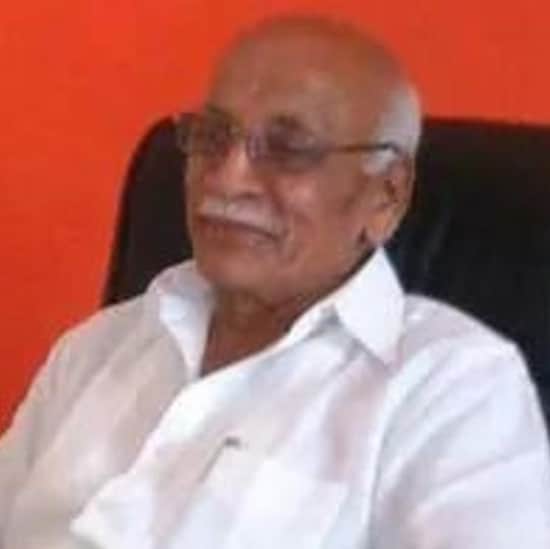
Twenty years after the sensational killing of Congress leader Pawanraje alias Bhupalsingh Santajiraje Nimbalkar and his driver Samad Abdul Wahid Kazi, a special CBI court in Mumbai has acquitted all nine accused, including former Maharashtra Home Minister Padamsinh Patil.
The verdict marks the conclusion of one of Maharashtra’s longest-running and most politically sensitive criminal cases.
Court Finds Evidence Insufficient
Special CBI Judge Satyanarayan Navandar acquitted all nine accused, ruling that the prosecution failed to establish the charges beyond reasonable doubt.
Those acquitted include former minister Padamsinh Patil, businessman Satish Mandade, former municipal councillor Mohan Shukla, Parasmal Badala, alleged shooters Dinesh Tiwari and Pintusingh Chaudhary, BSP worker Kailash Yadav, Gyanendra Pande and former State Excise officer Shashikant Kulkarni.
The prosecution had alleged that the accused were part of a conspiracy to eliminate Nimbalkar because of an intense political rivalry. However, the court concluded that the available evidence was not sufficient to secure convictions.
The 2006 Double Murder
According to investigators, Nimbalkar and his driver were travelling from Mumbai to Pune on June 3, 2006, when their vehicle was intercepted near Kalamboli in Navi Mumbai.
Prosecutors claimed that attackers blocked the vehicle before opening fire, killing both Nimbalkar and Kazi at the scene.
The case initially baffled investigators, with local police failing to identify the perpetrators despite extensive inquiries.
Widow’s Petition Led to CBI Probe
The investigation gained momentum after Nimbalkar’s widow, Anandibai Nimbalkar, approached the Bombay High Court seeking a Central Bureau of Investigation (CBI) inquiry.
In her petition, she alleged that Padamsinh Patil was the prime suspect and linked the murder to a bitter political feud that emerged after differences surfaced between the two leaders in the early 2000s.
She claimed her husband had become a political threat to Patil following a closely contested Assembly election and disputes involving local cooperative institutions and public issues.
The High Court later transferred the investigation to the CBI after observing that the local probe had reached a dead end.
CBI’s Conspiracy Theory
The CBI built its case around the testimony of Parasmal Badala, who later became an approver.
According to investigators, a murder-for-hire plot was allegedly organised through multiple intermediaries. The agency claimed financial transactions, meetings and recruitment of alleged shooters were part of a wider conspiracy to eliminate Nimbalkar.
The CBI further alleged that the motive stemmed from a political fallout linked to allegations surrounding the Kargil fund controversy and disclosures reportedly made by social activist Anna Hazare.
To support its case, the agency examined 127 witnesses during the lengthy trial, including Anna Hazare.
End of a Two-Decade Legal Battle
The acquittal brings an end to a legal battle that spanned two decades, multiple investigations, court transfers and extensive witness examinations.
While the prosecution maintained that the accused orchestrated a politically motivated assassination, the court ultimately ruled that the evidence presented did not meet the threshold required for conviction.
The verdict closes a chapter in one of Maharashtra’s most closely watched political murder cases, though it is likely to spark debate among legal experts and political observers regarding the challenges of securing convictions in complex conspiracy cases after long delays.