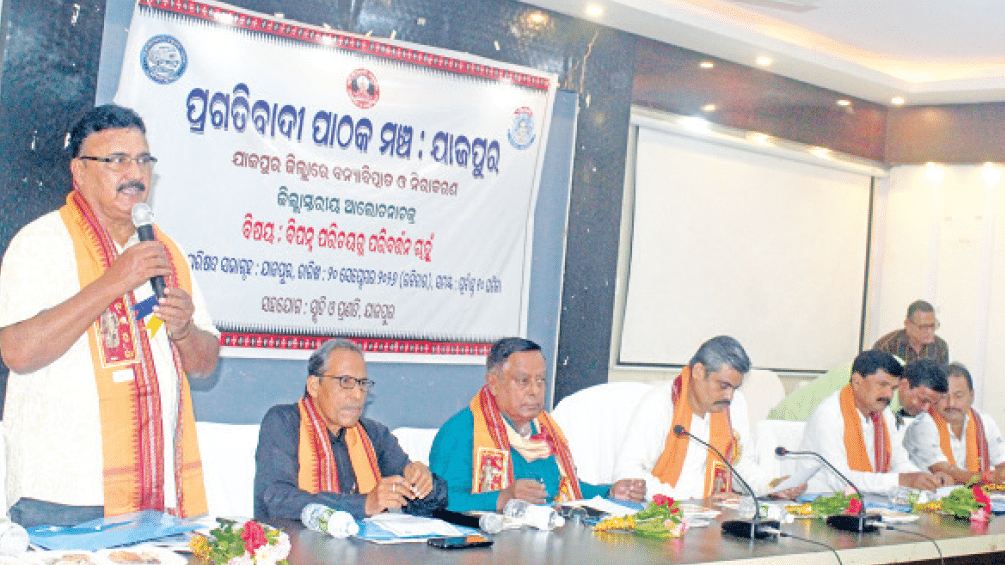
A unanimous call for a permanent, engineering-led solution to Jajpur’s chronic flood menace took centre stage at the Jajpur Zilla Parishad Conference Hall.
Organised by the Pragativadi Pathaka Mancha under the theme “Bipanna Parichayara Paribartana Chahun” (We Want a Change in Our Identity of Being Vulnerable), intellectuals, social activists, retired administrators, and political leaders across party lines assembled to demand urgent government intervention.
The forum urged the state government to constitute a High-Power Technical Committee and draft a comprehensive Master Plan to protect flood-prone blocks including Bari, Binjharpur, Dasarathapur, Badachana, and Dharmasala.
Administrative Apathy & Illegal Construction Fueling the Crisis
Speakers at the symposium pointed out that administrative inertia, lack of political willpower, and uncoordinated development projects have turned natural seasonal water flows into devastating disasters.
Key issues highlighted during the discussions include:
-
Unregulated Encroachments & Sand Mining: Illegal construction along riverbeds and indiscriminate sand mining in the Baitarani, Brahmani, and Kani rivers have severely obstructed natural drainage pathways and altered river courses.
-
Upstream Hydroelectric Dam Impact: Allegations were levelled against the hydroelectric project at Anandapur in Kendujhar district. Speakers noted that the project holds back around 12 meters of water and suddenly releases massive volumes during heavy rainfall, triggering sudden severe flooding downstream in the Baitarani basin.
-
Protracted Waterlogging: Floodwaters remained trapped for over 45 days in several regions this season, collapsing rural transport, education, and agrarian livelihoods.
“In the name of development, destruction is being created due to unplanned projects and a lack of long-term vision. We need long-term engineering solutions rather than temporary fixes.”
— Shishir Kumar Nayak, State Convenor, Pragativadi Pathaka Mancha
Key Recommendations Proposed at the Forum
To transition Jajpur from a state of perpetual relief dependency to long-term resilience, panel members presented several actionable proposals:
-
Integrated Detailed Project Report (DPR): Prepare a unified DPR combining flood control, irrigation, and drainage management systems across the district’s river systems.
-
Revival of Stalled Projects: Fast-track the long-pending Bhimkund Reservoir Scheme on the Baitarani River and the Madanpur (Aali) Cut Project to manage excess discharge.
-
River Interlinking & Upstream Barrages: Interlink major rivers with smaller canals to balance water volume, and construct upstream barrages on the Brahmani, Baitarani, and Kharasrota rivers.
-
Concrete Embankments & Plantation: Construct reinforced concrete embankments along vulnerable stretches of the Kochila, Kani, and Budha rivers, backed by community-driven tree plantation drives to strengthen riverbanks.
-
Post-Flood Recovery for Farmers and Students: Provide targeted financial revival packages for farmers whose crops were fully destroyed, and organise special remedial classes for students who missed over a month of schooling due to submerged institutions.
A Call for Accountability
Former Jajpur Zilla Parishad Chairman Gautam Ray emphasised that public silence on systemic failures has aggravated the region’s vulnerability. He stressed that those responsible for violating environmental norms or obstructing natural waterways must be held strictly accountable under the law.
With millions suffering prolonged displacement every rainy season, leaders agreed that Jajpur’s identity must shift from a chronic disaster zone to a model of resilient infrastructure—requiring decisive action before the next monsoon arrives.