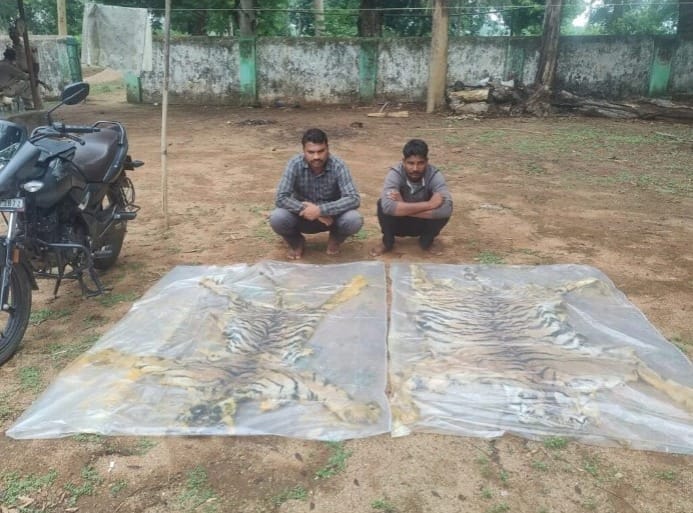
In a significant boost to wildlife conservation efforts, authorities have achieved a major breakthrough under ‘Operation Safe Passage’, seizing two tiger skins and arresting two active poachers in Chhattisgarh.
The joint operation, driven by intelligence inputs, has delivered a sharp setback to an inter-state wildlife trafficking network.
Acting on credible tips, teams from the Chhattisgarh Forest Department and allied agencies conducted raids in the Paschim Paral Kot range of Kanker district. The operation led to the arrest of Babu Rao Mandvi and Bijeshwar Gidam, with two tiger pelts recovered from their possession. A case has been registered under relevant wildlife protection laws (POR-390/09) by the Bhanupratappur Forest Division, and investigations are ongoing.
This success builds on recent momentum in the region. Earlier, a poacher was arrested in the Abujhmad area of Bastar for hunting nine Indian giant squirrels, highlighting the department’s intensified crackdown on organised wildlife crime.
Senior officials say these repeated actions are visibly weakening the networks that threaten endangered species.

Varun Jain, Deputy Director of the Tiger Reserve, welcomed the development, stating: “Continuous strict operations are resulting in increased unrestricted movement of tigers through wildlife corridors. This is a positive sign for conservation.”The operation underscores the critical importance of the Gadchiroli–Indravati–Abujhmad–Udanti–Sitanadi–Sunabeda wildlife corridor, which serves as a vital lifeline for tigers and other rare species across central India. Protecting and restoring this corridor remains a top priority for safe passage and population recovery.
The Chhattisgarh Forest Department has reiterated its firm ‘Zero Tolerance’ policy against wildlife crimes. In the coming days, it plans to ramp up coordinated enforcement, legal action, forest habitat restoration, and corridor security measures.
This latest strike, detailed in an official press release from the department, sends a clear message: organised poaching will not be tolerated in the region. Conservationists view it as an encouraging step toward securing the future of India’s iconic wildlife.