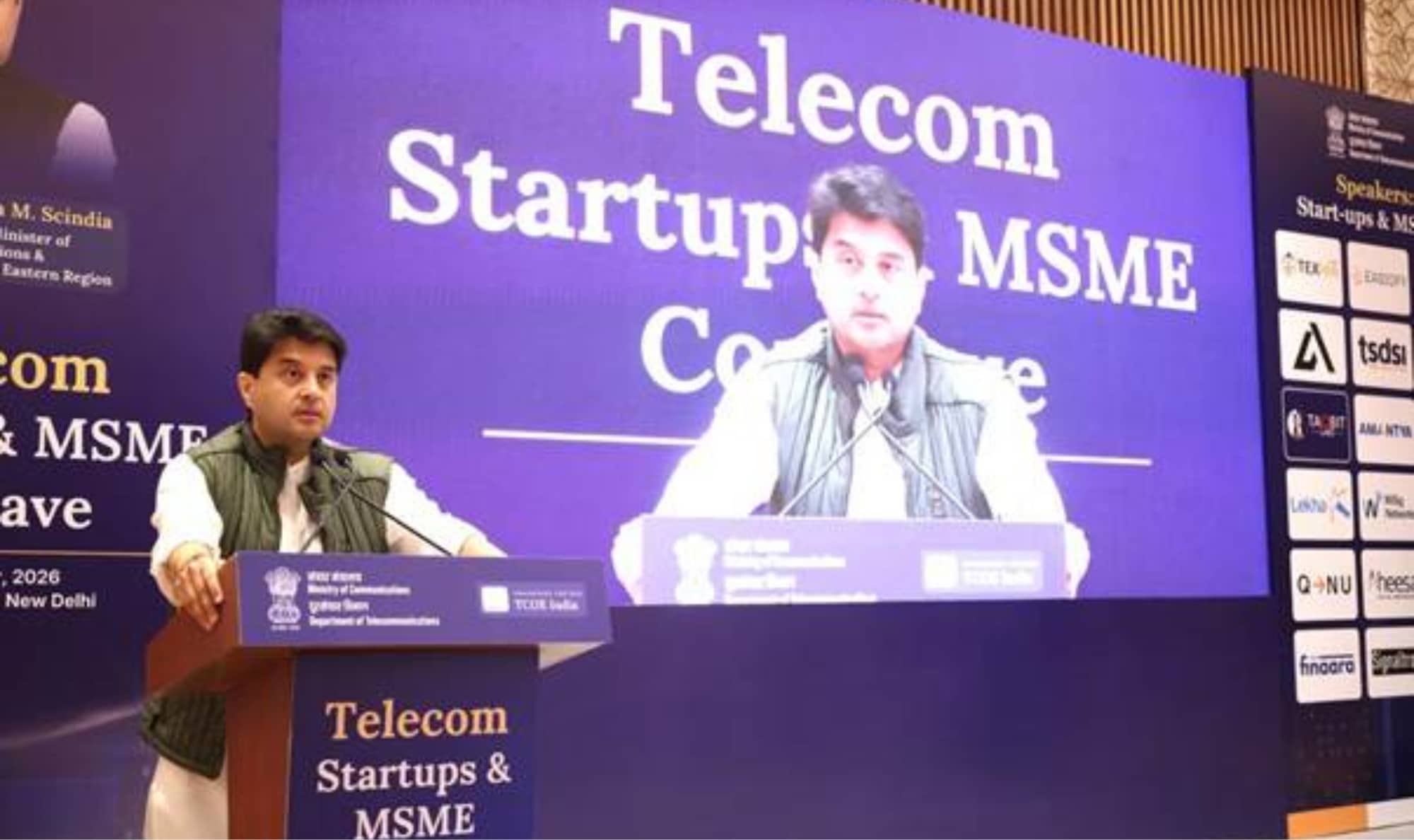
Union Minister for Communications and Development of North Eastern Region Shri Jyotiraditya M. Scindia on Tuesday chaired the Telecom Startups and MSME Conclave 2026 at Leaders Lounge, Bharat Mandapam, rallying domestic innovators, industry leaders, investors, and academics to accelerate the build-out and commercialisation of homegrown telecom technologies.
Addressing the gathering organised by the Department of Telecommunications (DoT), Ministry of Communications, Scindia underscored a decade-long shift in India’s technological standing. “Over the last decade, India has moved from being the consumer of technology to becoming the creator of technology,” he said, pointing to the telecom sector as its clearest proof point thanks to the sheer scale available to test new solutions.
Scindia noted that India’s startup count has surged from just a few hundred in 2014 to more than 2,00,000 today, alongside its rise as the world’s fourth-largest economy and market. Within telecom, he highlighted rapid expansion from 25 crore internet connections to 110 crore, and from 6 crore broadband connections to 104 crore—making India the only telecom network market growing at double-digit rates.
Focus Across the Telecom Stack and Policy Enablers
Keynote speaker Debjani Ghosh, Distinguished Fellow at NITI Aayog and Chief Architect of the NITI Frontier Tech Hub, emphasised deeper stakeholder collaboration and an enabling environment for technology-led entrepreneurship.
Technical discussions and presentations spanned five core pillars of the telecom stack:
-
Radio Access Network (RAN) and Core
-
Applications
-
Chipsets
-
Security
-
Standards
DoT officials walked participants through existing support programmes—including the Telecom Technology Development Fund (TTDF), the Technology Development and Investment Promotion (TDIP) Scheme, and 100 5G Use Case Labs—designed to aid research and development, standardisation, validation, and deployment. The Department also pointed to Captive Non-Public Networks (CNPNs) and Regulatory Sandbox frameworks under the Telecommunications Act, 2023, as practical levers for enterprise deployments and live testing. Dedicated sessions on captive telecom services and the regulatory sandbox featured DoT officials alongside global industry perspectives from Ericsson.
Startups and MSMEs also demonstrated indigenous products across 11 exhibition stalls set up at the venue.
Emerging Technologies Hackathon 2026 Winners Felicitated
During the conclave, Scindia recognised winners of the Emerging Technologies Hackathon 2026 (ETH 2026), organised by TCoE India, which drew over 2,870 registrations and 620 applications across nine technology domains:
-
First Prize: Entra Innovations LLP for VAAYU, an indigenously designed tyre-pressure sensor system-on-chip.
-
Second Prize: Dawniens International Private Limited for Cablesmith, a robotic optical patch panel solution enabling remote provisioning of fibre connections.
-
Joint Third Prize: IIT Bombay (Team DRISTI) for KAVACH, a security engine for private 5G networks, and the Military College of Telecommunication Engineering (Team RUDRA) for VajraLink, an anti-jamming communication solution for drones.
Reaffirming DoT’s alignment with the Viksit Bharat@2047 vision, the conclave focused on turning early-stage R&D and pilot breakthroughs into scalable commercial products for domestic and global markets.