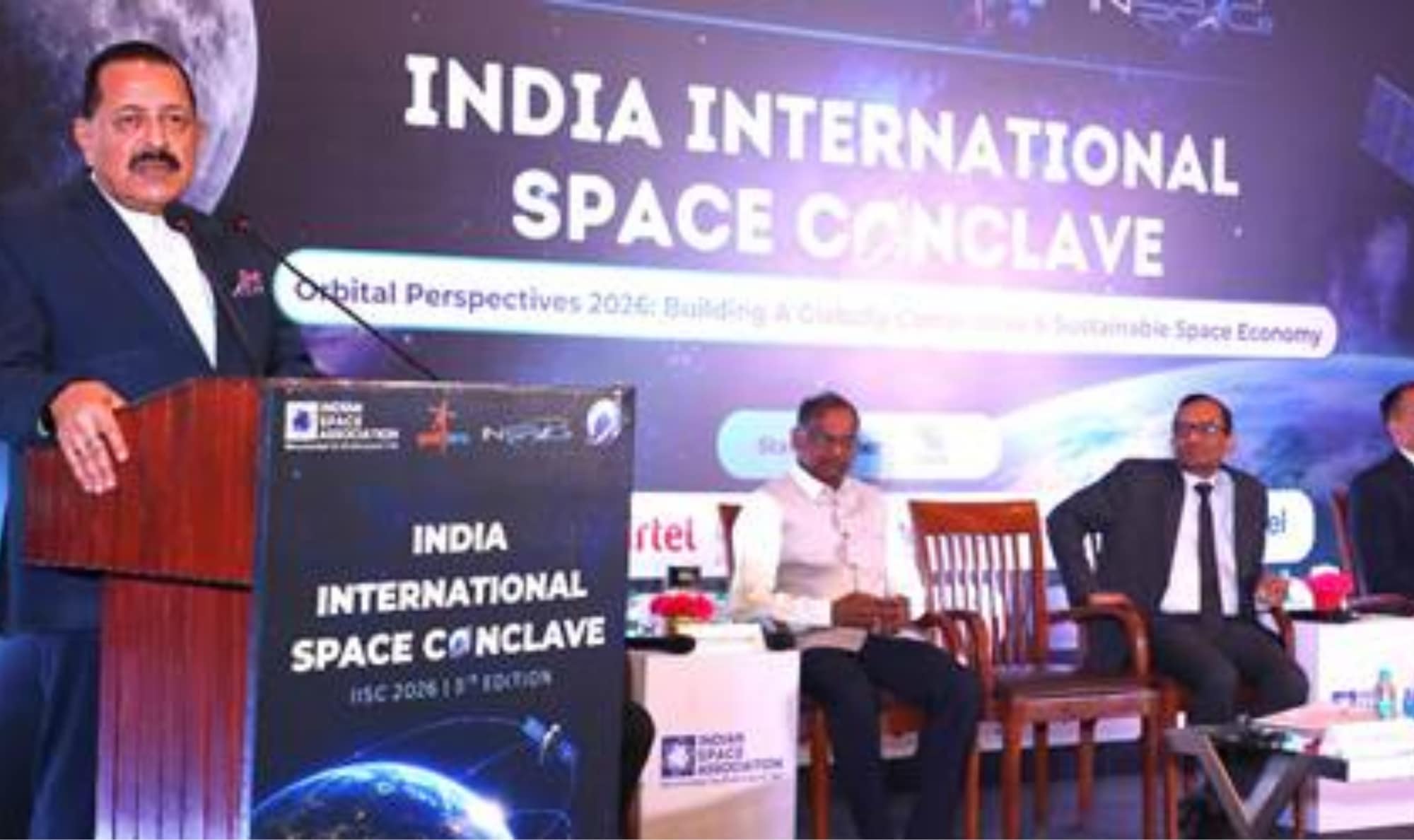
India’s space economy is poised to surge from nearly USD 9 billion today to between USD 40 billion and USD 45 billion in less than a decade, propelled by private-sector entrepreneurship, commercial breakthroughs, and sweeping policy reforms, Union Minister Dr Jitendra Singh said on Tuesday.
Addressing the fifth India International Space Conclave 2026—a two-day gathering organised by the Indian Space Association (ISpA) on November 23–24 in New Delhi around the theme “Shaping the Future of Space through Innovation, Governance, Human Potential and Global Collaborations”—Dr. Singh noted that India’s space ecosystem has expanded from single-digit startups to roughly 400–500 companies within a few years. The conclave also saw the release of the report “Space Economy 2036: The India Blueprint.”
Reforms Break Old Boundaries
Dr Singh pointed to the creation of New Space India Limited (NSIL) and IN-SPACe, alongside opening the sector to private players, as watershed policy shifts that moved space capabilities beyond state monopoly. Leaders across the ecosystem—including ISRO Chairman and Department of Space Secretary Dr V. Narayanan, IN-SPACe Chairman Dr Pawan Kumar Goenka, ISpA Director General Lt Gen Anil Kumar Bhatt (Retd), and Arun T. Ramchandani—joined industry stakeholders and researchers at the event.
Highlighting homegrown momentum, the Minister cited Skyroot Aerospace’s maiden launch vehicle flight on July 18, 2026, its multi-mission launch agreement, and its rise to unicorn status. He also pointed to Agnikul and other firms advancing propulsion systems, privately built rocket engines, Earth observation, and satellite imaging, while noting growing interest from established industrial groups.
Value Beyond the Launchpad
True economic impact, Dr Singh argued, goes well beyond launch contracts and hardware sales to include ground-level efficiency and savings. Under the PM Gati Shakti National Master Plan, space-based tools are helping streamline infrastructure planning, keep timelines on track, lower costs, and curb wastage and leakages. Across virtually every ministry—spanning infrastructure, construction, communication, education, healthcare, railways, and defence—space applications are becoming core public infrastructure.
Addressing questions on building domestic demand during an interactive session, Dr. Singh said gaps in perceived demand often stem from limited awareness of practical space applications beyond rockets and satellites. Whole-of-government coordination and inter-ministerial teamwork are key to scaling adoption. On global ties, he stressed that indigenous self-reliance—anchored in domestic sources, technology, and projects—complements rather than conflicts with international partnerships.
Quantum Milestones and a Call for R&D Philanthropy
Dr. Singh also highlighted progress under the National Quantum Mission, launched in 2023 with an eight-year mandate: India has already reached 1,000 kilometres in secure quantum communication within three years, compared with an original goal of 2,000 kilometres over eight years. Linking space, quantum technologies, semiconductors, and nuclear science as mutually reinforcing growth engines, he urged domestic companies to expand investments and tap global networks to draw foreign capital.
While pointing to tools such as the Anusandhan National Research Foundation and the Research, Development and Innovation (RDI) Fund, the Minister called on industry leaders to channel more Corporate Social Responsibility (CSR) funds into scientific research rather than limiting CSR to physical machinery or infrastructure. Building a stronger culture of scientific philanthropy, he said, benefits society at large. He also welcomed ideas on a global space innovation alliance, startup accelerators, international grand challenges, and broader state-level and youth participation.