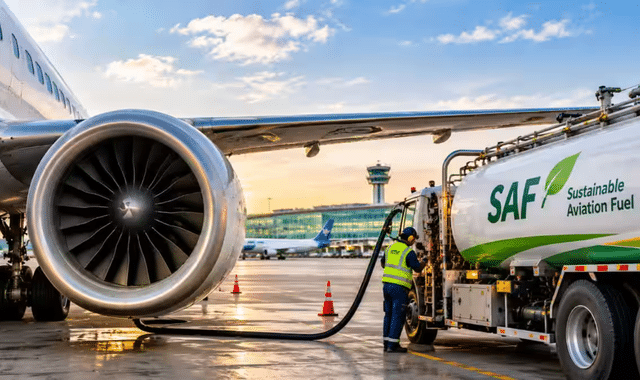
India’s aviation sector is set for a structural green transition starting in 2027, when airlines operating in the country will be required to blend Sustainable Aviation Fuel (SAF) with conventional Aviation Turbine Fuel (ATF).
According to a draft National Policy on Sustainable Aviation Fuels circulated by the civil aviation ministry, the blending requirement will begin at 1 per cent in 2027 and progressively scale up to 40 per cent by 2040.
The proposed policy mandates the use of indigenously manufactured SAF derived from agricultural residues, used cooking oil, and municipal solid waste.
To prevent “economic tankering”—where airlines load excess fuel abroad to avoid higher local costs—the draft requires carriers operating international flights to uplift at least 90 per cent of their annual sector fuel requirements from Indian international airports.
To bolster domestic manufacturing, the government has proposed financial incentives, including GST waivers, tax holidays, and Viability Gap Funding. Additionally, an apex body—the National Council on Sustainable Aviation Fuel (NC-SAF)—and a digital tracking registry under the Directorate General of Civil Aviation (DGCA) will oversee implementation.
With national ATF consumption projected to reach 14.2 million tonnes by 2030, estimates indicate India could produce 10 million tonnes of SAF annually by 2040, requiring an estimated investment of $70–85 billion across the aviation value chain.