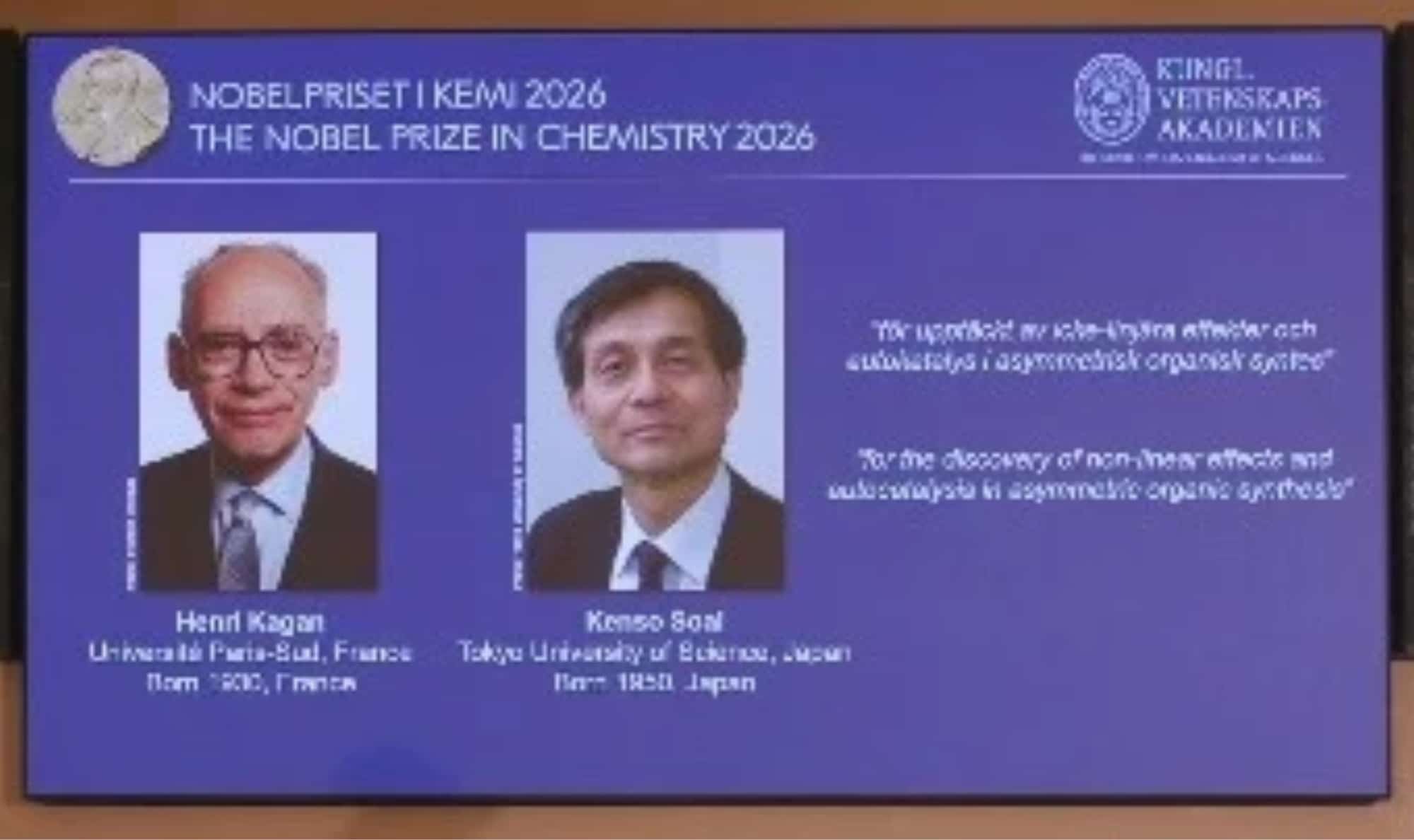
The Royal Swedish Academy of Sciences announced on Wednesday that the 2026 Nobel Prize in Chemistry has been awarded to French chemist Henri Kagan and Japanese chemist Kenso Soai.
The two scientists were recognized for their monumental discovery of non-linear effects and autocatalysis in asymmetric organic synthesis, a breakthrough that transformed how researchers construct handed molecules.
Henri Kagan, affiliated with Université Paris-Sud in Orsay, France, and 95-year-old Kenso Soai of the Tokyo University of Science, unlocked a fundamental secret of nature’s architecture. Many organic molecules exist in two mirror-image forms—much like left and right hands. In pharmaceuticals and material science, producing pure quantities of just one mirror image is often critical, as the wrong “hand” can alter a medicine’s effect or render it ineffective.
Discovering a dynamic new path for manipulating these chemical reactions, Kagan’s foundational work revealed that a tiny initial imbalance in chiral catalysts could be multiplied into a far greater excess of one mirror-image form than scientists previously assumed possible. Meanwhile, Soai’s discovery of asymmetric autocatalysis demonstrated that a molecule could act as a catalyst for its own creation, exponentially amplifying handedness and shedding light on how life’s single-handed molecular symmetry may have originated.
This year’s award follows last year’s recognition of three scientists who developed revolutionary porous molecular architectures capable of trapping vast quantities of gas—paving the way to capture atmospheric greenhouse emissions and harvest water from desert air. Building on chemistry’s track record of addressing fundamental global challenges, the 2026 laureates’ discoveries provide the essential blueprints required to construct precise complex molecules for next-generation medicine, agriculture, and industrial applications.
You can watch an insightful summary of how groundbreaking chemistry research earns the prestigious award in the 2025 Nobel Chemistry Prize Video. This video explains the context and significance of recent Nobel recognition in chemistry, helping viewers understand how monumental discoveries shape the field.