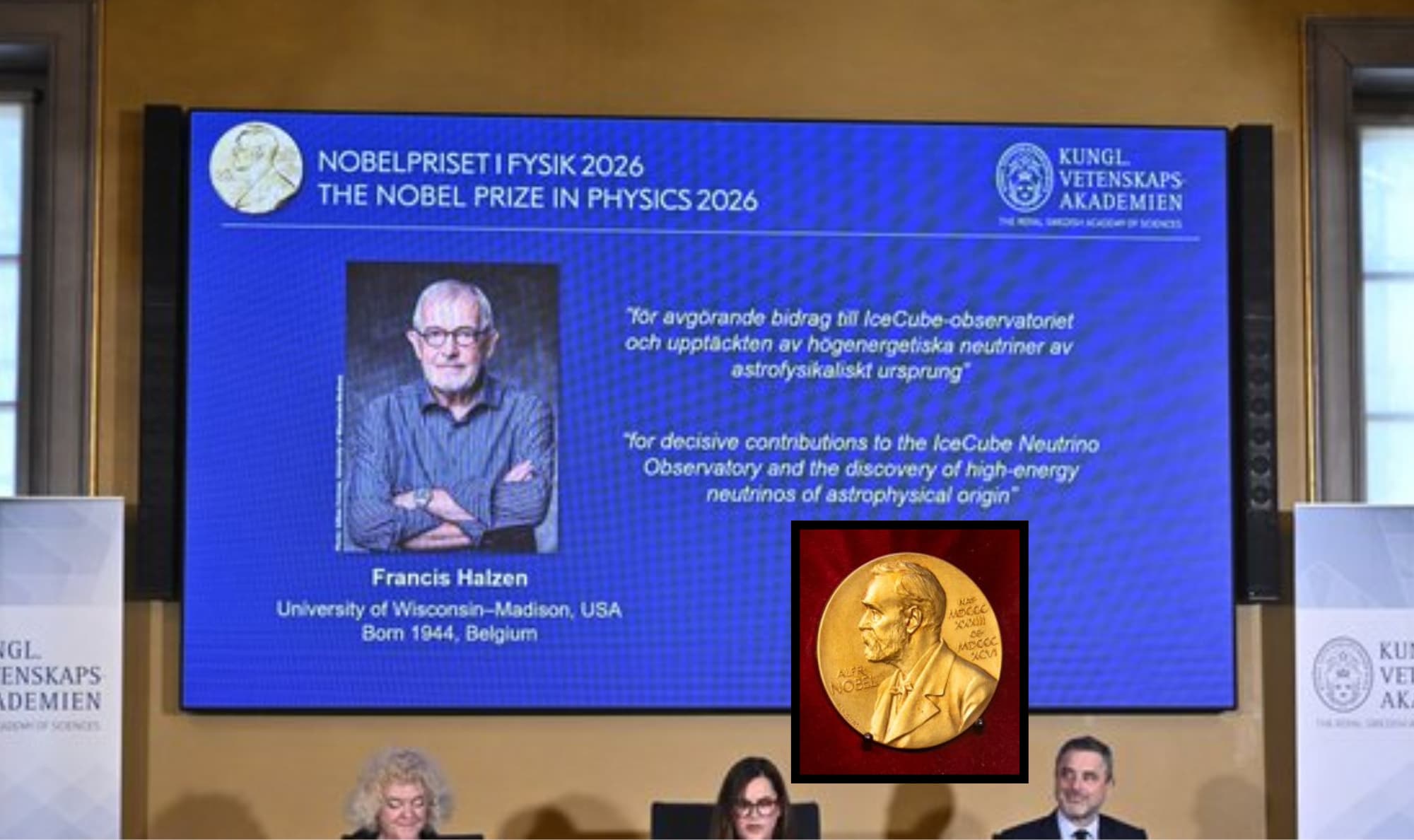
Francis Halzen has been awarded the Nobel Prize in Physics for his visionary contributions to the IceCube Neutrino Observatory and the landmark discovery of high-energy neutrinos of astrophysical origin.
The announcement, made by the Royal Swedish Academy of Sciences, marks the dawn of an entirely new era in astronomy—one that peers into the deepest, most violent corners of the universe using elusive, ghost-like subatomic particles rather than light.
“Francis Halzen has led an international team of researchers and engineers who have provided us with a fantastic instrument,” said Mark Pearce, chair of the Nobel Committee for Physics, in a news release. “His tenacity and scientific vision have paved the way for a new kind of astronomy.”
A Journey to the End of the Earth
Born in Belgium, the 82-year-old laureate is a distinguished professor affiliated with the University of Wisconsin–Madison in the United States, which serves as the lead institution for the IceCube facility. Halzen’s relentless quest to capture high-energy cosmic neutrinos began back in the 1980s, a decades-long pursuit that ultimately culminated in a massive detector embedded deep within the glacial ice at the South Pole in Antarctica.
Unlike traditional telescopes that rely on photons (light), IceCube transforms a cubic kilometre of pristine Antarctic ice into a giant particle detector. It captures the faint flashes of blue light produced when cosmic neutrinos interact with the ice, allowing scientists to trace these messengers back to their violent cosmic origins, such as black holes and active galactic nuclei.
The 2026 Nobel Announcements
Halzen receives the prestigious prize alongside a monetary award of 12 million Swedish kronor (approximately $1.2 million).
The physics announcement follows Monday’s opening of the Nobel season, which awarded the prize in medicine to three scientists for developing light-based tools to study brain function. The announcements continue this week with chemistry on Wednesday, literature on Thursday, the peace prize on Friday, and concluding with the economic sciences prize next Monday.
Halzen’s groundbreaking work ensures that humanity’s view of the cosmos will never be the same, turning the frozen expanse of the South Pole into a window to the stars.