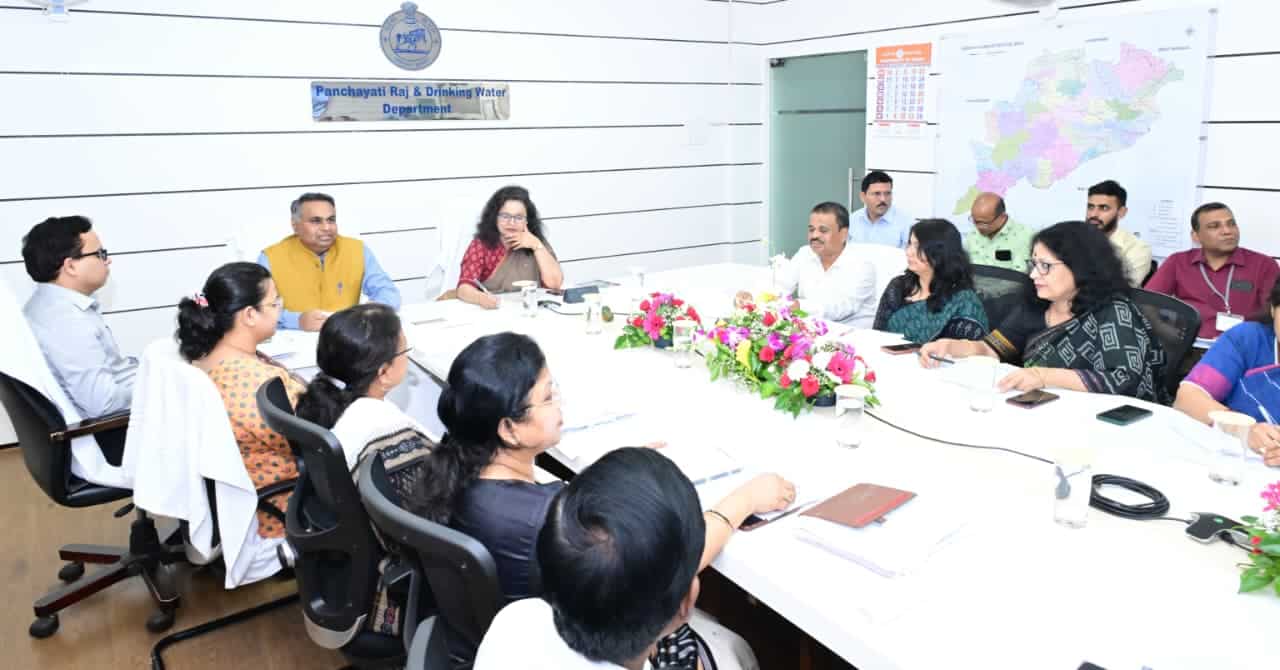
Odisha Chief Secretary Anu Garg today visited the Panchayati Raj and Drinking Water Department at Lok Seva Bhawan and conducted a comprehensive review of its ongoing programmes and progress.
She interacted with senior departmental officers as well as field-level functionaries from districts and blocks who joined virtually.
Highlighting the critical role of the department in delivering basic amenities to rural Odisha, the Chief Secretary stressed that achieving the goals of Viksit Odisha by 2036 and Viksit Bharat by 2047 demands greater dedication, determination and collective resolve. She called upon every officer and staff member to become active partners in this transformative journey.
Smt. Garg outlined the three core pillars of the Odisha Vision Document: robust infrastructure development (roads, bridges, power, railways, industry and airports), improved health, nutrition, skill development and education, and the pursuit of economic equality. She emphasised the need to boost rural livelihoods, enhance value-added production in sectors such as fish, eggs and milk, promote tourism, and drive overall economic growth in villages so that every section of society benefits.
Special focus was placed on permanently solving drinking water issues in rural areas through strategic planning, alongside sanitation, roads, electricity connectivity and internet access for all villages. The Chief Secretary encouraged officials to develop model villages at the block level, effectively implement Mahapurusha Adarsh Gram and Godabarisha Adarsh Primary School initiatives, and approach every scheme with higher ambition and stronger morale. She also advised attention to road repairs, drain maintenance, flood control and creating a clean, beautiful rural environment.

Commissioner-cum-Secretary of the department, Shri Girish S.N., briefed the Chief Secretary on key achievements. Under the rural drinking water mega pipeline scheme, 43 of 207 projects have been completed and water supply has begun from 86 projects, with remaining works being expedited. Small pipeline projects stand at 97% completion (18,782 projects), targeted for full completion by October. Solar-based water supply projects have reached 74% completion (6,656 projects), to be finished by December. Functional household tap connections are operational in 21,324 villages and standposts in 7,034 villages, with the priority of ensuring water for every household.
Under the “Viksit Gaon, Viksit Odisha” initiative, 20,975 of 22,917 projects taken up in 2024-25 have been completed with an expenditure of ₹936.22 crore. In 2025-26, 16,347 of 42,140 projects have been completed with ₹626.06 crore spent. Annual action plans for 278 of 314 blocks for 2026-27 have already been approved.
Odisha has become the second state in the country to complete all required processes under VV-G-RAM G and begin wage, material and administrative payments within the stipulated timeframe. Under MGNREGS, employment has been provided to 1.29 lakh families in 30 migration-prone blocks, generating 35.52 lakh person-days, with 578 families completing 100 days of work. In the last two years, 5,24,583 rural houses have been completed under various housing schemes (PMAY, PM-Janman and Antyodaya). Additionally, ₹151 crore in incentive amounts has been released to 98,613 beneficiaries.
The Chief Secretary expressed confidence that the department’s officers and staff, working at the grassroots and addressing people’s basic needs, will continue to play a decisive role in bringing a new awakening in rural Odisha and realising the vision of a developed state.