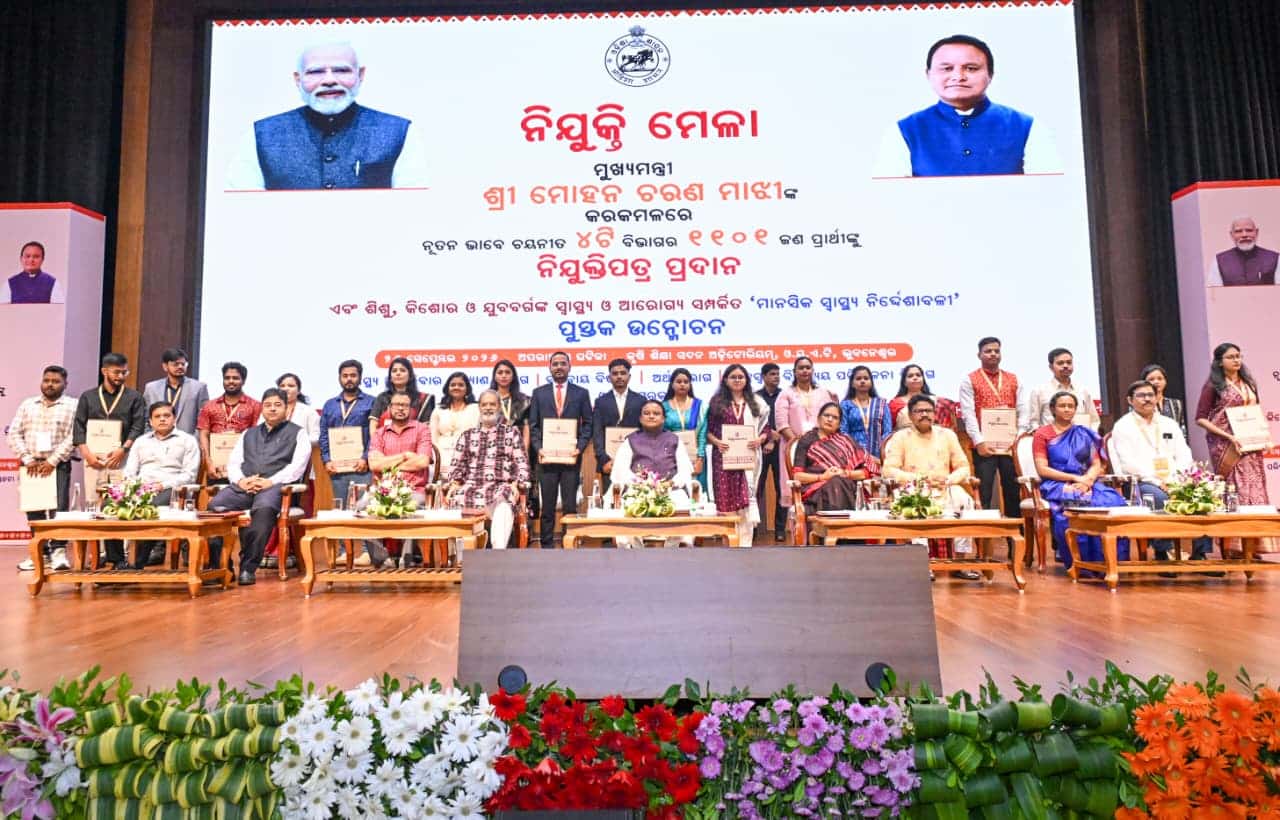
A government job is not just a paycheck or a secure desk. It is a sacred chance to serve the state and society. That was the message Odisha Chief Minister Mohan Charan Majhi delivered on Saturday as he handed appointment letters to 1,101 newly recruited officers at the 17th state-level Nijukti Mela.
The ceremony was held at Krushi Shiksha Sadan on the Odisha University of Agriculture and Technology (OUAT) campus in Bhubaneswar. In two years and three months since the present government took office, 17 such fairs have together placed 46,575 young men and women in government service — a figure the Chief Minister held up as proof that the state is serious about turning youth aspiration into public duty.
“Samriddha Odisha 2036 and Viksit Bharat 2047 will rest on the competence, integrity and sense of duty of these new officers,” Majhi said.
Who joined today
The largest share went to Health and Family Welfare: 814 Medical Officers and 92 Assistant Professors. The rest joined the core administrative and financial cadres — 30 in the Odisha Administrative Service (OAS), 42 in the Odisha Revenue Service (ORS), 46 in the Odisha Finance Service (OFS), 60 in the Odisha Taxation and Accounts Service (OTAS), and 17 in the Cooperative Service (OCS and OCAS).
That split matches the government’s own pre-event briefing: 906 in Health, 72 in Revenue and Disaster Management, 106 in Finance, and 17 in Cooperation.
To the new doctors, the Chief Minister had a simple brief: treat Odisha’s 4.5 crore people as family. Health Minister Dr Mukesh Mahaling said the 906 health appointments would ease the shortage of doctors in rural, remote and tribal areas and push the state closer to a “Swastha Odisha.”
The five-point mantra
Majhi then gave the new officers a *Pancha Sutri* — five rules of public office.
First, do not think of yourselves as rulers. Think of yourselves as *janasevaks*. Service to the people, he said, is service to Madhava.

Second, treat corruption as poison for a career. The government’s zero-tolerance policy stays in force, and the Vigilance Department has been given full operational independence.
Third, remember that great power comes with great responsibility. Protect the dignity of the post.
Fourth, give the highest priority to *Jana Sunani* — public hearings and grievance redressal. Complaints must be heard and closed quickly.
Fifth, keep the government’s image clean at the grassroots.
He also praised the recruits for clearing a fiercely competitive process. Government jobs, he noted, still account for only about 4 per cent of total employment in the state. Those who made it, he said, did so through hard work and the blessings of their families.
A first for the country
On the same stage, Odisha launched what the CMO called the country’s first age-wise *Mental Health Guidelines* booklet — covering children from the pre-primary stage through youth. The handbook was prepared jointly by the Education, Health and Family Welfare, Women and Child Development, and Skill Development departments. Officials said it is meant to strengthen the mental well-being of the next generation, not only treat illness after it appears.
What other leaders said
Deputy Chief Minister Kanak Vardhan Singh Deo asked the officers to become role models in their departments — new thinking, high ethics, and visible results at the village level.
Deputy Chief Minister Pravati Parida told them the appointment letter was not a mere certificate. It was recognition of years of study, focus and family sacrifice. That effort, she said, must now be spent on ordinary citizens.
Revenue and Disaster Management Minister Suresh Pujari struck a sharper note: studies are not over; the real examination begins now. A job is only the means. The goal is service to the country and to people. “We will all leave this earth. What remains is our work.”
Finance Department Principal Secretary Sanjeeb Kumar Mishra delivered the welcome address. Health Department Commissioner-cum-Secretary Aswathy S. proposed the vote of thanks. Cooperation Director Rajesh Prabhakar Patil and Director of Health Services Dr Mahesh Mohan Panda were among those on the dais, along with families of the new officers.
The political frame was unmistakable: fill vacancies fast, keep recruitment visible, and bind new officers to a public-service ethic before they reach their first posting. Whether the *Pancha Sutri* changes how files move and how people are heard will be tested not on the OUAT stage, but in clinics, tehsils and cooperative offices across Odisha.