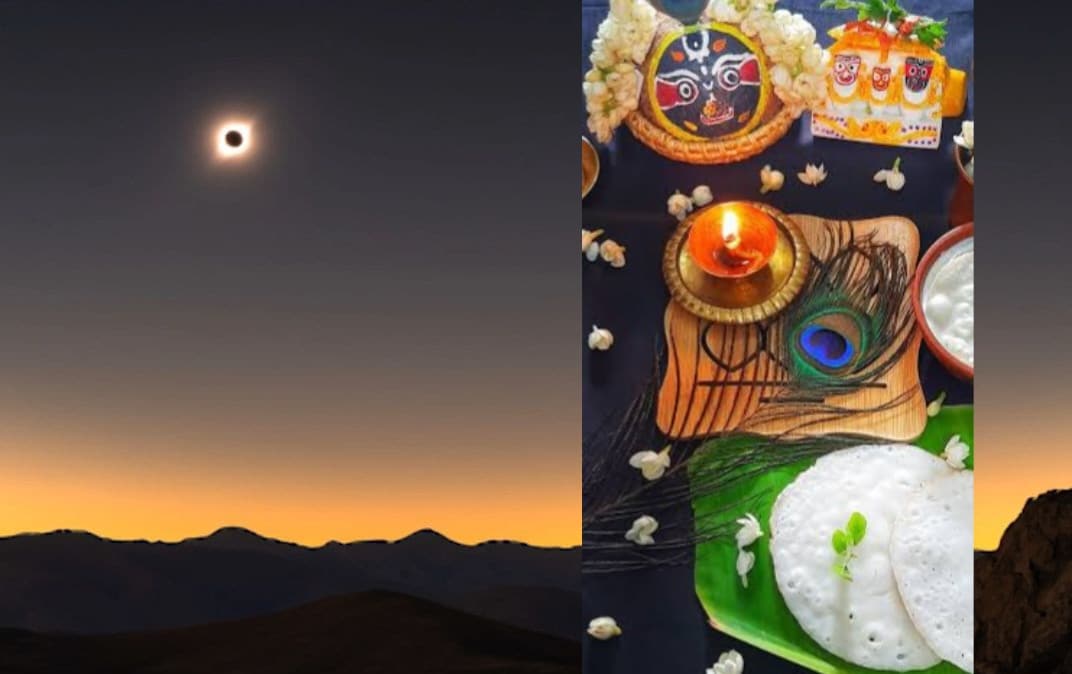
Chitalagi Amavasya 2026 coincides with the final solar eclipse of the year, creating interest among devotees and astronomy enthusiasts in Odisha. However, the eclipse will not be visible from Odisha or anywhere else in India.
The solar eclipse will take place on Wednesday, August 12, with the total phase lasting about 2 minutes and 18 seconds. The phenomenon will be visible from parts of Europe and North America, while some locations along the path of totality will experience a brief period of daytime darkness.
Will the solar eclipse be visible in Odisha?
No. The August 12, 2026 solar eclipse will not be visible from India, including Odisha.
According to the information available, the eclipse will begin at around 11:20 pm IST. Since the event will not be visible from Odisha, questions have emerged about whether traditional eclipse-related restrictions and rituals will be observed in the state.
Why is the eclipse not visible in India?
A solar eclipse is visible only from specific parts of Earth where the Moon’s shadow falls. During a total solar eclipse, the Moon moves directly between the Earth and the Sun and temporarily blocks the Sun’s visible disc for observers within the path of totality.
For the August 12 eclipse, the path of totality will stretch from Greenland to Iceland and parts of northeastern Spain. Parts of North America will also witness the eclipse in its partial phase.
Since Odisha lies outside the visibility zone, residents will not be able to observe the celestial event from the state.
Chitalagi Amavasya and eclipse rituals in Odisha
The coincidence of Chitalagi Amavasya and the solar eclipse has raised questions about whether religious rituals and traditional practices associated with an eclipse will be followed in Odisha.
Since the eclipse will not be visible from India, religious practices may depend on the established traditions and guidance followed by individual temples and religious institutions.
For devotees, the key point is that the eclipse itself will not be visible in Odisha. Any temple-specific decision regarding rituals, timings or observances would be determined by the respective authorities and religious traditions.
What happens during a total solar eclipse?
A total solar eclipse occurs when the Moon passes directly between the Earth and the Sun. From locations within the path of totality, the Moon completely covers the Sun’s visible disc for a short period.
The sky can become noticeably darker during totality, creating the appearance of night during the daytime.
The August 12 eclipse is the second and final solar eclipse of 2026.