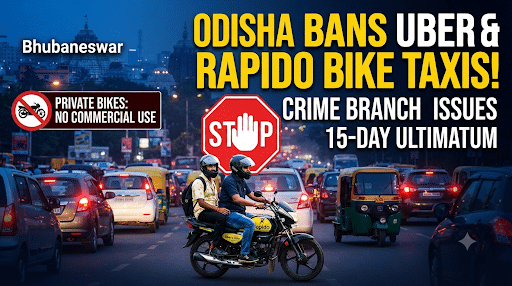
A major crackdown on online bike taxi services is underway in Odisha, as the state Crime Branch has officially directed ride-hailing platforms Uber and Rapido to suspend their two-wheeler passenger transport operations.
The decision comes in response to glaring violations of the Motor Vehicle Act, which strictly prohibits the commercial use of private two-wheelers.
In a formal notice addressed to the nodal officers of Uber and Rapido, the Crime Branch highlighted that utilizing motorcycles with private registration plates for commercial passenger transport is illegal. The authorities have granted the companies a strict 15-day window from the receipt of the notice to completely shut down their bike taxi operations across the state. Furthermore, the companies are required to submit a compliance report to both the Crime Branch and the State Transport Authority.
If the platforms fail to halt their services within the stipulated timeframe, the Crime Branch has warned of severe legal consequences. To ensure strict compliance, the authorities have instructed the service providers to implement geo-fencing technology to block all bike booking facilities within Odisha’s geographical boundaries.
While this directive brings bike taxi rides to an abrupt halt, it offers a sigh of relief for four-wheeler and three-wheeler commuters. The authorities clarified that this ban exclusively applies to two-wheeler passenger transport. Uber’s cab services, as well as auto-rickshaw rides on both platforms, will continue to operate normally without any new restrictions.
Traditionally, operating a private motorcycle for commercial passenger transport requires specific commercial permits and registrations, which most gig-economy bike taxis currently lack. The Crime Branch’s intervention is aimed at enforcing these legal requirements and ensuring passenger safety and regulatory adherence.
However, the ban is expected to trigger significant disruptions for daily commuters and gig workers. Thousands of drivers who rely on these platforms for their daily livelihood will be directly impacted. For urban commuters, especially in cities like Bhubaneswar and Cuttack, bike taxis have served as an affordable, fast, and highly convenient mode of navigating through heavy traffic. With this service taken off the roads, daily riders will now be forced to seek alternative, potentially more expensive transit options.
While the move is being praised by transport unions and authorities as a necessary step for road safety and legal compliance, the sudden shift leaves a massive gap in the state’s micro-mobility sector. All eyes are now on how Uber and Rapido will respond to the directive, and whether they will attempt to introduce a commercially registered fleet of two-wheelers to navigate the regulatory hurdle in the future.