In a landmark moment for space exploration, the four astronauts aboard NASA’s Artemis II mission have become the farthest humans ever to travel from Earth, reaching a maximum distance of 252,752 miles (approximately 406,765 km) during their daring lunar flyby.
This achievement surpasses the previous record set by the Apollo 13 crew in 1970 by roughly 4,102 miles. Apollo 13 astronauts reached about 248,655 miles from Earth before their emergency return. NASA confirmed the new milestone as the Orion spacecraft, named *Integrity*, looped around the far side of the Moon and began its journey home.
Commander Reid Wiseman, Pilot Victor Glover, Mission Specialist Christina Koch, and Canadian Space Agency astronaut Jeremy Hansen are conducting the first crewed test flight of the Artemis program. Unlike earlier Apollo missions that entered lunar orbit, Artemis II follows a “free-return trajectory,” allowing the crew to slingshot around the Moon without entering orbit or landing. The mission focuses on testing Orion’s systems for future crewed lunar landings.
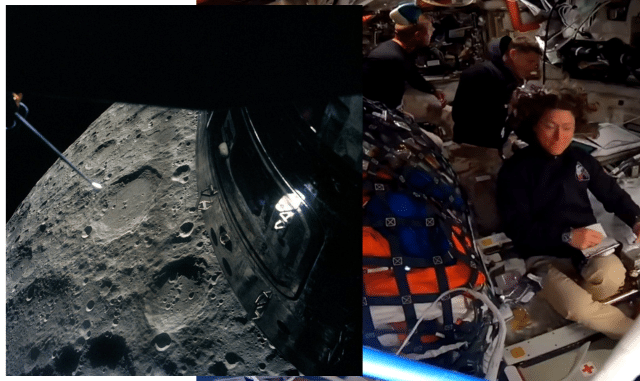
As the spacecraft made its closest approach to the Moon—passing approximately 4,070 miles above the lunar surface—the crew captured stunning views of the far side, areas never before seen directly by human eyes. Mission Control in Houston monitored the event live, with astronauts performing observations and systems checks while briefly out of radio contact behind the Moon.
“This is a new milestone for humankind,” NASA stated, highlighting the significance of pushing the boundaries of human spaceflight once again after more than five decades.
A new milestone for humankind: The crew of Artemis II are now the farthest any human has ever travelled, reaching a maximum distance of 252,752 miles from Earth.
This surpasses the previous record set by Apollo 13 in 1970 by about 4,102 miles. pic.twitter.com/DbLFvvdEfT
— NASA (@NASA) April 6, 2026
The Artemis II mission launched on April 1, 2026, aboard the powerful Space Launch System (SLS) rocket from Kennedy Space Center in Florida. It marks NASA’s first crewed journey beyond low-Earth orbit since Apollo 17 in 1972 and serves as a critical precursor to Artemis III, which aims to return astronauts to the lunar surface.
The crew has reported smooth operations aboard Orion, with the spacecraft performing exceptionally well. Christina Koch noted that while the team doesn’t dwell on superlatives, this record is a tangible way to connect the legacy of Apollo with the ambitions of Artemis and future deep-space exploration.
As Artemis II continues its approximately 10-day voyage, culminating in a Pacific Ocean splashdown, the mission is already delivering valuable data on deep-space travel, radiation exposure, and spacecraft performance with humans aboard.
This record-breaking flight not only honours the past but propels humanity toward a sustained presence on the Moon and, eventually, deeper into the solar system.
LIVE: Watch with us as the Artemis II astronauts make their closest approach to the Moon, traveling farther from Earth than ever before. https://t.co/Zpy7GdTqA8
— NASA (@NASA) April 6, 2026