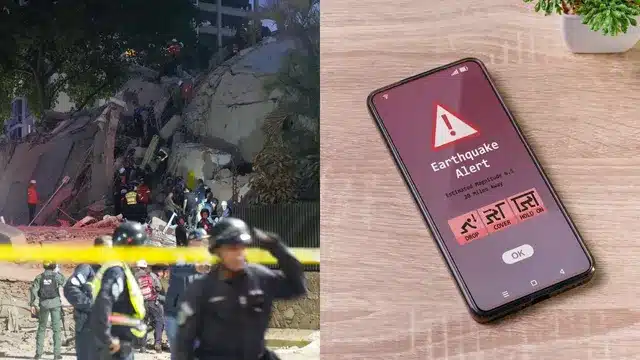
Google’s Android Earthquake Alerts System successfully detected seismic activity in Venezuela and sent early warning notifications to Android users seconds before powerful earthquakes struck the country, demonstrating how smartphones are becoming an important tool in disaster preparedness.
A Google official confirmed that the company’s earthquake detection technology identified the initial tremors and issued alerts before the seismic waves reached many users. While the company did not disclose the number of people who received the notifications, the incident highlights the growing role of mobile technology in providing life-saving warnings.
How Google’s Android Earthquake Alerts System Works
The Android Earthquake Alerts System uses two different methods depending on the region.
1. Dedicated Seismic Networks
In California, Oregon, and Washington, Google works with the US ShakeAlert network, which uses more than 1,600 ground-based seismic sensors. When an earthquake is detected, the system quickly sends information to Android devices.
2. Crowdsourced Smartphone Detection
In most other countries, including India and Venezuela, the system relies on millions of Android smartphones.
Every Android phone contains an accelerometer, a sensor capable of detecting unusual ground vibrations. When multiple nearby devices detect similar movement, anonymous signals are sent to Google’s servers.
The servers analyze the incoming data to determine whether an earthquake is occurring, effectively transforming millions of smartphones into a large-scale virtual seismic monitoring network.
Two Types of Earthquake Alerts
Google issues alerts only for earthquakes measuring magnitude 4.5 or higher.
Be Aware Alert
- Sent when light shaking is expected.
- Functions like a regular notification.
- Respects the user’s volume, silent mode and Do Not Disturb settings.
Take Action Alert
- Issued when moderate to severe shaking is expected.
- Overrides silent mode.
- Activates a loud alarm and lights up the phone screen.
- Provides emergency safety instructions and an estimated earthquake location.
Why Seconds Matter During an Earthquake
Electronic alerts travel much faster than seismic waves.
This allows smartphones to receive warnings before the shaking begins, giving people valuable time to:
- Move away from falling objects.
- Get off ladders or elevated platforms.
- Drop, cover and hold on.
- Alert family members nearby.
Even a warning of just a few seconds can significantly reduce injuries during strong earthquakes.
Real-World Success
Google has cited several successful deployments of the system.
During the 6.7-magnitude Philippines earthquake in November 2023:
- The first alert was issued 18.3 seconds after the earthquake began.
- People closest to the epicentre received up to 15 seconds of warning.
- Others farther away received as much as one minute of advance notice.
- Nearly 2.5 million Android users were alerted.
Available in Nearly 100 Countries
Google launched the Android Earthquake Alerts System in partnership with ShakeAlert in the United States in 2020.
Its crowdsourced earthquake detection expanded internationally in 2021 and is now available in 98 countries, including India.
The service complements official government earthquake warning systems and does not replace national disaster management agencies.
Study Shows High Accuracy
A peer-reviewed study published in the journal Science in July 2025 evaluated the system’s performance over three years.
According to the research:
- The system detected an average of 312 earthquakes every month.
- Around 60 earthquakes of magnitude 4.5 or higher triggered public alerts each month.
- Approximately 18 million Android devices received earthquake notifications during the study period.
- 85% of surveyed users who received alerts reported actually feeling the earthquake.
- 36% received the warning before the shaking started, while others received alerts during or shortly after the tremors began.
Growing Role of Smartphones in Disaster Preparedness
The Venezuela earthquakes once again demonstrated how smartphones are becoming a critical component of early warning systems. By combining built-in sensors with cloud-based data analysis, Google’s Android Earthquake Alerts System provides millions of people with valuable seconds to react before an earthquake strikes.
As the technology continues expanding across more regions, smartphone-based earthquake detection is expected to strengthen global disaster preparedness and help reduce the impact of future seismic events.