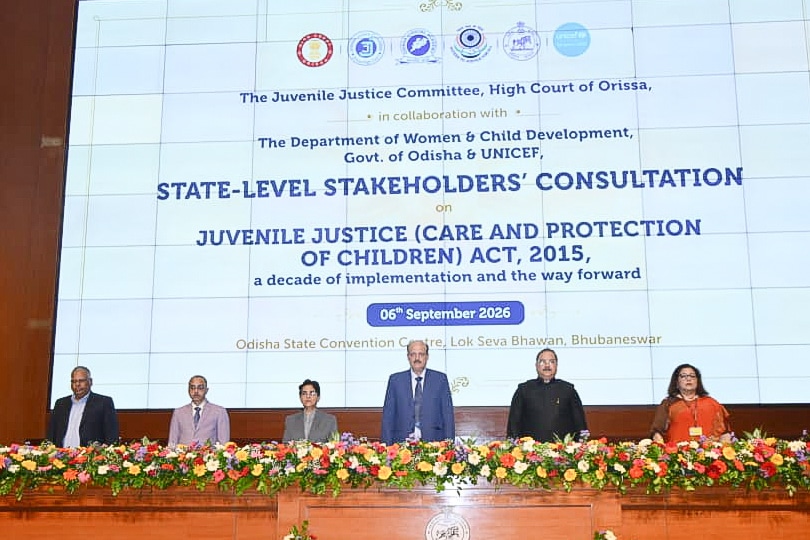
Reflecting on ten years of the Juvenile Justice (Care and Protection of Children) Act, 2015, key policymakers, judicial officers, and child rights advocates gathered in Bhubaneswar on Sunday to chart a stronger, prevention-focused roadmap for Odisha’s children.
The State-Level Stakeholders’ Consultation, jointly organized by the Juvenile Justice Committee of the High Court of Orissa, the Department of Women & Child Development, and UNICEF Odisha, served as both a retrospective review and a forward-looking strategy session.
Delivering the keynote address, Hon’ble Chief Justice of the High Court of Orissa, Justice Harish Tandon, underscored a crucial shift in philosophy: keeping children out of the system in the first place. “Prevention must be at the heart of juvenile justice,” Justice Tandon stated. “We must address vulnerabilities at the grassroots so that children do not come into conflict with the law or enter institutional care.”
The inaugural session featured comprehensive overviews of the JJ Act’s regional implementation from Hon’ble Justice Savitri Ratho, Chairperson of the Juvenile Justice Committee; Dr. Mrinalini Darswal, Commissioner-cum-Secretary of the Women & Child Development Department; and Mr. Prasanta Dash, UNICEF’s Chief of Field Office for Odisha.
To break down the complexities of child protection, the consultation was divided into four targeted technical panels:
- Rights of Children in Conflict with Law: Led by resource person Dr. Kalpana Purushothaman, experts including senior police officials and judicial magistrates examined the nuances of preliminary assessments for heinous offenses, alongside the pre- and post-production processes essential for genuine rehabilitation.
- Rights of Children in Need of Care and Protection (CNCP): Facilitated by Ms. Nimisha Srivastava, this panel tackled vulnerability mapping and the prevention of family separation. Discussions heavily featured the integration of children with special needs and the critical role of Child Welfare Committees.
- Family-Based Care and Adoption: Steered by Mr. Prabhat Kumar, panelists—including District Collectors and academic directors—emphasized a shift away from institutionalization. The dialogue championed family strengthening, foster care, sponsorship, and robust aftercare programs.
- Offenses Against Children: With rising modern threats, this panel, facilitated by Mr. Vedprakash Gautam and featuring Padma Shri awardee and anti-human trafficking expert Ms. Sunitha Krishnan, focused on making police and court procedures more child-friendly. It also highlighted the urgent need to protect youth from emerging risks like cybercrime, online exploitation, and substance abuse.
Stakeholders acknowledged that while the 2015 Act drastically reformed India’s juvenile justice architecture—improving adoption processes and aligning services under Mission Vatsalya—the next decade requires intensified inter-departmental coordination. Upgrading infrastructure, building the capacity of frontline workers, and establishing greater district-level accountability were identified as immediate priorities.
Concluding the landmark event, Hon’ble Justice M.S. Raman, Judge of the High Court of Orissa and member of the Juvenile Justice Committee, delivered the vote of thanks, commending the unified effort of the judiciary, government, and civil society in securing a safer future for Odisha’s youth.