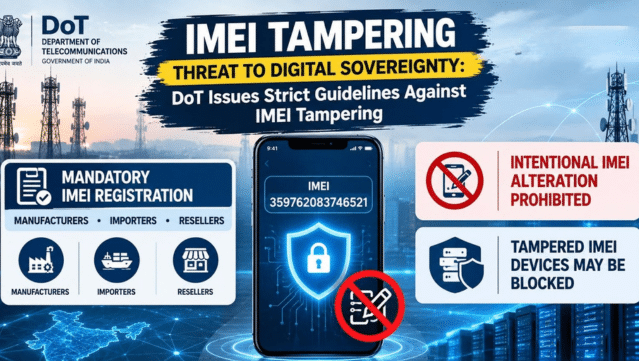
As India’s mobile subscriber base expands rapidly to reach 1,204.01 million active connections, the Department of Telecommunications (DoT) has issued an official notice highlighting the severe cybersecurity threats posed by unlawful International Mobile Equipment Identity (IMEI) tampering.
With mobile networks forming the backbone of digital payments, online commerce, and citizen services, securing device identifiers has become paramount for national network integrity and law enforcement operations.
Understanding IMEI and Unlawful Tampering
The IMEI is a unique 15-digit identity code assigned to mobile hardware. The first eight digits represent the Type Allocation Code (TAC), allocated globally by the Global System for Mobile Communications Association (GSMA) to classify specific device models. Dual-SIM devices typically feature two distinct IMEI numbers.
According to the DoT, it is strictly unlawful for any individual or entity to:
- Intentionally remove, obliterate, change, or alter unique mobile device identification numbers.
- Intentionally produce, traffic, use, or possess hardware/software reconfigured to alter telecommunication identifiers.
Mandatory Compliance Across the Value Chain
To stop cloned or counterfeit devices from entering the telecom ecosystem, the government enforces strict obligations through the Device Setu–Indian Counterfeit Device Restriction (ICDR) portal:
- Manufacturers & Importers: Must register the IMEI numbers of all telecom devices (including smartphones, cellular smartwatches, modems, and SIM boxes) on the Device Setu portal before sales, R&D, or customs clearance.
- Brand Owners: Must link their official GSMA TAC registrations on the portal to verify device authenticity.
- Sellers & Resellers: Must verify devices against the central database of tampered and blacklisted IMEIs before completing sales or trade-ins of pre-owned hardware.
Citizen Guidelines and Verification
Citizens are urged to avoid purchasing devices with configurable IMEIs, using fraudulent documents for SIM registration, or transferring SIM cards to unknown parties.
To verify device authenticity, users can:
- Dial
*#06#to view the device’s hardware IMEI. - Cross-verify details via the Sanchar Saathi web portal, mobile app, or by texting
KYM <15-digit IMEI>to 14422.
In case of loss or theft, citizens should immediately file a police report, obtain a duplicate SIM card, and submit a blocking request via the Sanchar Saathi (CEIR) portal to disable the missing handset across all Indian cellular networks.
Stringent Legal Safeguards & Penalties
| Regulation / Provision | Legal Basis & Consequences |
| Governing Law | Telecommunications Act, 2023 |
| Primary Violation Provisions | Section 42(3)(c) (Tampering with identifiers) & Section 42(3)(e) (Fraudulent acquisition) |
| Penalties | Imprisonment up to 3 years, fines up to Rs 50 lakh, or both |
| Legal Status of Offence | Cognizable and Non-Bailable under Section 42(7) |
| Abetment Liability | Equal punishment for promoters or accomplices under Section 42(6) |