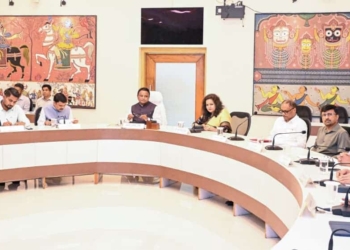
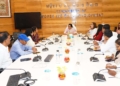
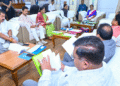
An all-party meeting at the Odisha Legislative Assembly ended on Monday with a familiar appeal and an equally familiar warning. Speaker Surama Padhy asked ruling and opposition members to help run the House smoothly. The Opposition made clear it intends to test that request from the first hour of the monsoon session.
The seventh session of the 17th Assembly opens on Tuesday, September 22, and runs until October 3. There will be nine working days. Officials say the Speaker used Monday’s meeting to discuss the agenda, the conduct of business, and the need for constructive debate on public issues and important bills.
Chief Minister Mohan Charan Majhi attended, along with Deputy Chief Minister Kanak Vardhan Singh Deo, Parliamentary Affairs Minister Dr. Mukesh Mahaling and Law Minister Prithviraj Harichandan. From the other side of the aisle came BJD deputy leader Prasanna Acharya, Opposition chief whip Pramila Mallik, deputy chief whip Pratap Keshari Deb and Congress legislature party leader Ramachandra Kadam and Congress MLA Ashok Das, among others. Leader of Opposition Naveen Patnaik were not present.
Padhy’s message was straightforward: keep the House peaceful so that legislation and public-interest matters can be discussed. Parties present signalled agreement in principle. The temperature outside the room told a different story.
The flashpoint is the Mines and Minerals (Development and Regulation) Amendment Act, 2026. BJD and Congress plan to use the short session to corner the BJP government over the law’s impact on mineral-rich Odisha. Acharya said the party would raise the issue from the opening of the session. BJD has alleged that the amendment could cost the state nearly ₹1 lakh crore in mining-related arrears that flowed from a 2024 Supreme Court ruling on states’ power to tax mineral-bearing land. The party has also cited a potential annual revenue hit of around ₹12,000 crore.
After the meeting, Mallik said BJD had submitted a motion seeking a detailed discussion on Odisha’s losses under the amended law. The Speaker, she added, had agreed to consider it. “We have waited. Otherwise we will act according to the party’s decision. Whether we cooperate in running the House or not will be decided by our party,” she said.
The government struck a more open note. Mahaling said six bills are likely to be introduced and that the administration is ready to discuss issues of state interest, including MMDR, in whatever form the Speaker permits. Majhi later posted that his government wanted consensus and cooperation for a “prosperous and Viksit Odisha.”
That polite framing may not last long. Opposition parties have a longer list ready: textbook errors, law and order, agrarian distress, women’s safety, tribal rights, flood management and the Mahanadi water dispute. Security around the Assembly has already been tightened, with a large police deployment planned for the session.
Nine sitting days is a short window. For BJD and Congress, it is long enough to force the mining law onto the floor. For the Speaker, it is just long enough to test whether Monday’s appeal for order survives Tuesday’s first clash.