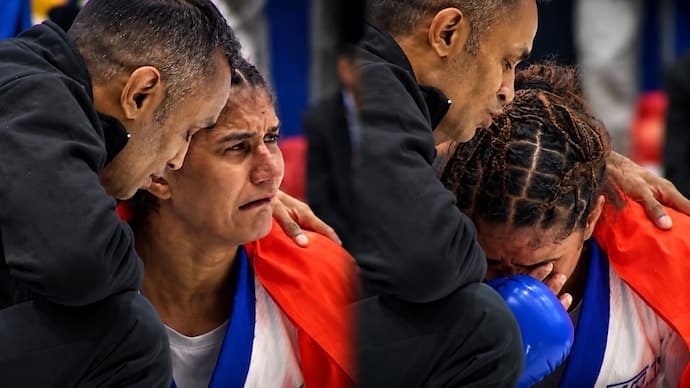
Suchika Tariyal scripted history for India at the Asian Games 2026 by winning a bronze medal in the women’s traditional 60kg MMA category. But her path to the medal was marked by a dramatic semifinal that was ultimately decided by a difference of just 700 grams.
Tariyal faced Singapore’s Hui Hoon Teo in a closely fought semifinal. The Indian fighter used her judo skills effectively, taking Teo to the ground on multiple occasions and attempting to gain control.
Teo, however, had the edge in boxing and took the opening round. Tariyal responded strongly in the second, managing another takedown and controlling her opponent for a period.
With the two fighters level after regulation time, the bout went into a one-minute overtime.
Teo wins after overtime tie
During the extra minute, Teo managed to control the contest as Tariyal attempted to land punches. When the result was initially announced, Tariyal appeared unhappy and protested the decision.
The Indian MMA federation subsequently challenged the result by paying a USD 1,000 protest fee. A review of the footage by the judges changed the result to a draw.
That, however, did not end the contest.
How 700 grams decided the semifinal
Under Asian MMA rules, a tied bout after overtime goes through a series of tiebreakers. Officials first consider warnings received by the fighters. If those are equal, judges consider advice given during the contest.
If those factors also cannot separate the athletes, their pre-competition weights are compared.
That rule proved decisive for Tariyal.
Teo was approximately 700 grams lighter than the Indian fighter at the morning weigh-in. As a result, she was awarded the bout through a “Break Tie by Weight” and advanced to the final.
“Since the Singaporean was lighter than Suchika by around 700 grams, she moved to the final. Suchika settled for bronze,” MMA Sports Federation president Nikhil Kunde told PTI.
What the MMA tiebreaker rules say
The rules provide a specific sequence for deciding a tied contest after overtime.
Officials first check whether either fighter received warnings. If the number of warnings is identical, the advice given to the fighters is considered. If that also fails to separate them, their pre-competition weights are compared.
If those weights are identical, post-competition weights are taken into account. Should those too be equal, three assistant referees can decide the winner by raising flags.
In Tariyal’s case, the weight comparison ended the contest in Teo’s favour.
Historic bronze for India
Despite missing out on the final, Tariyal’s achievement marks a landmark moment for Indian MMA.
The 36-year-old became India’s first Asian Games MMA medallist, securing a bronze in the traditional 60kg category.
Her run to the podium included a fiercely contested semifinal and an unusual tiebreaker that brought the importance of weigh-ins into sharp focus.
For Tariyal, the result meant disappointment at missing the gold-medal opportunity but also a place in Indian sporting history as the country’s first Asian Games MMA medallist.