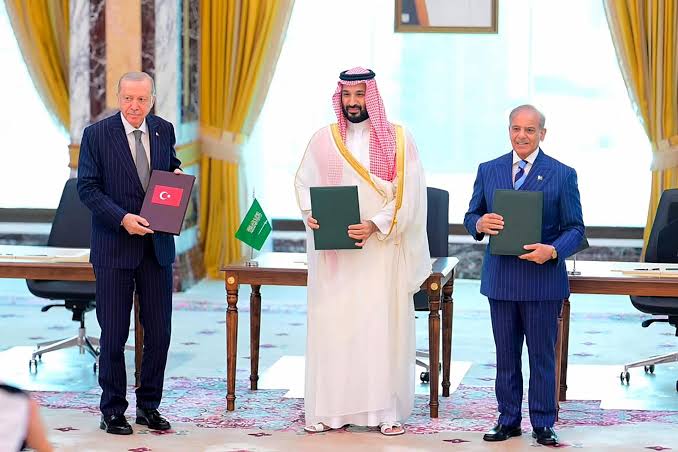
Turkey, Saudi Arabia and Pakistan are set to hold their first ministerial-level meeting of a newly formed regional defence grouping in Istanbul on Monday, following the signing of a landmark defence agreement in Mecca earlier this month.
The meeting comes amid heightened geopolitical tensions in the Middle East and is expected to bring together senior political and military officials from all three countries.
Pakistan’s Deputy Prime Minister and Foreign Minister Ishaq Dar is expected to attend the meeting, along with the country’s defence minister and military leadership.
What is the Mecca Defence Pact?
The Mecca Joint Defence Agreement, signed earlier this month, commits Turkey, Saudi Arabia and Pakistan to mutual defence support.
Under the arrangement, an attack on one of the three countries would be treated as an attack on all, making the pact similar in principle to collective-defence arrangements such as NATO.
Why is the Istanbul meeting important?
The Istanbul meeting is expected to establish a more formal framework for cooperation between the three countries.
According to the report, the participants are expected to discuss establishing a political and defence strategic committee comprising foreign and defence ministers as well as military chiefs.
The proposed mechanism could provide a platform for coordinating responses to regional security challenges and strengthening military cooperation.
10 key points about the defence grouping
1. Mutual defence commitment:
Turkey, Saudi Arabia and Pakistan have agreed to provide defence support if any member comes under attack.
2. Regional tensions:
The pact comes amid heightened tensions in the Middle East, including the conflict involving the United States and Iran and attacks by Iran-backed Houthi rebels.
3. Strategic committee:
A key proposal at the Istanbul meeting is the creation of a political and defence strategic committee.
4. Senior leadership:
The proposed committee is expected to include foreign and defence ministers and the military chiefs of the three countries.
5. Three major military powers:
Turkey has NATO’s second-largest army, Pakistan is the only nuclear-armed state in the Islamic world, while Saudi Arabia is a major military and economic power in the Gulf.
6. Turkey to lead discussions:
Turkey is expected to play a central role in the Istanbul meeting, with its foreign and defence ministers and chief of general staff jointly chairing the discussions.
7. Pakistan’s delegation:
Islamabad is expected to send a high-level delegation led by Ishaq Dar, alongside its defence minister and military leadership.
8. Saudi representation:
Saudi Arabia is also expected to send senior political and military officials, including its foreign and defence ministers and chief of general staff.
9. Military cooperation:
The countries are expected to explore ways to strengthen defence capabilities and improve coordination and interoperability between their armed forces.
10. Defence industry collaboration:
Cooperation in defence production and the military industry is also expected to feature prominently, with Ankara seeking greater collaboration and improved interoperability.
A new regional security framework?
The Istanbul meeting marks an important step in translating the Mecca agreement into a more structured defence partnership.
While the three countries have different strategic priorities and relationships with major global powers, their cooperation could create a new mechanism for security coordination across the Middle East and wider Islamic world.
The extent to which the grouping develops into a permanent military and political alliance will depend on the institutional framework and commitments agreed upon in the coming meetings.