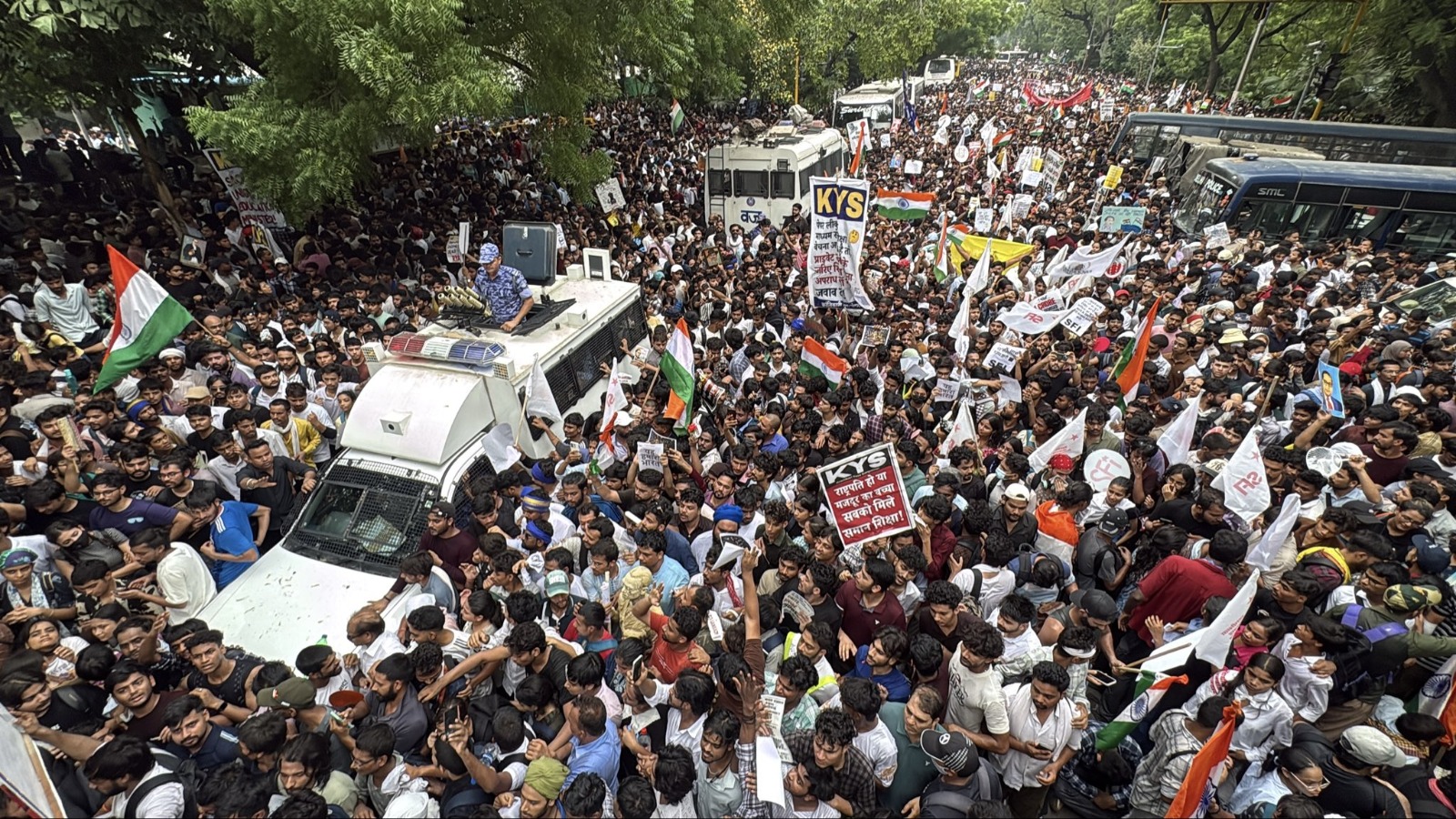

The storm that swept through Delhi this week was not one of rain or wind. It was a storm of anger, frustration and disappointment. Thousands of youth marched towards Parliament, not merely to protest against flaws in India’s education system, but to express a deeper resentment towards a government they believe has repeatedly ignored their concerns.
What began as a campaign led by Sonam Wangchuk and the Cockroach Janta Party (CJP) quickly transformed into a larger public movement. Turning the protest into a powerful demonstration of public sentiment, students, professionals, senior citizens and ordinary citizens joined the march. The government’s initial response, however, was familiar: barricades, lathi charges, tear gas and heavy police deployment.
Eventually, the Centre agreed to hold discussions with a delegation. Yet the dialogue came only after confrontation had escalated, and many of the protesters’ key demands, including the resignation of the Union Education Minister, remained unaddressed. The question is unavoidable: why must citizens first face force before they are heard?
Governments often mistake silence for consent. But democracy has a way of correcting that assumption. Public anger does not always emerge through political parties or parliamentary debates; sometimes it takes shape on the streets. The Delhi march served as a reminder that when institutions appear unresponsive, citizens themselves become the voice of opposition.
The BJP has, over recent years, succeeded in politically weakening much of the formal Opposition. Through defections, shifting alliances and electoral victories, it has consolidated significant influence. Yet no government should confuse a diminished parliamentary Opposition with the absence of public dissent. Democracies are ultimately sustained not by the strength of ruling parties but by the willingness of citizens to question those in power.
The protests also expose uncomfortable truths for the Opposition. Despite repeatedly raising issues related to education and unemployment, it has struggled to galvanise public participation to the extent seen during this movement. The spontaneous energy surrounding the CJP suggests that people increasingly respond to authentic, issue-based leadership rather than conventional political narratives.
This movement is not merely about education policy. It reflects broader anxieties over governance, accountability and the growing disconnect between policymakers and young Indians. With one of the world’s youngest populations, India cannot afford to treat its youth as a law-and-order problem rather than recognising them as stakeholders in the nation’s future.
The government would do well to remember that dialogue is always more effective than force. Batons may disperse crowds for a day, but they cannot silence legitimate aspirations. Equally, the Opposition must recognise that public trust cannot be inherited simply because the government faces criticism; it must be earned through meaningful engagement.
The events in Delhi have delivered a message to India’s political establishment. The loudest voice of dissent today may not come from Parliament. It may come from the streets, where ordinary citizens remind those in power that democracy belongs to the people, not just to those elected to govern them.
✍️ About the Author
Sabyasachi Kundu is a former journalist with extensive experience in political and social reporting. He currently works as a Senior Communication Consultant, focusing on public discourse, governance, and citizen engagement. His writings often explore the intersection of policy, protest, and democratic accountability, drawing on years of newsroom and field experience.
The author can be contacted at mail@sabyasachi.work.
⚖️ Disclaimer
The views and opinions expressed in this article are solely those of the author and do not necessarily reflect the editorial stance of Pragativadi.com. Pragativadi remains committed to providing a platform for diverse perspectives while upholding its editorial independence and integrity.