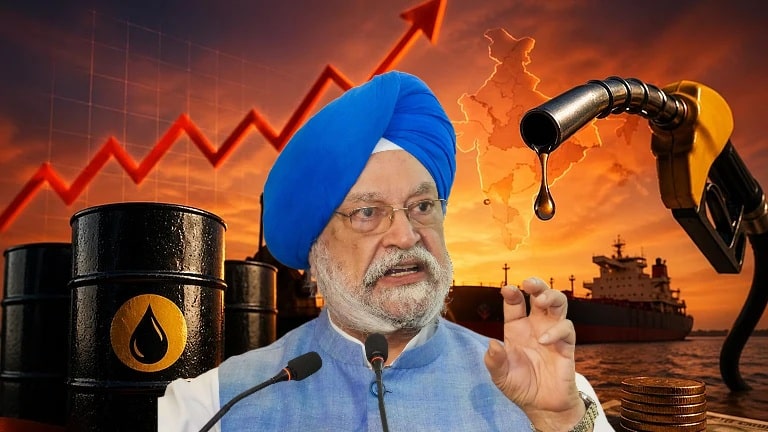
India’s energy security remains stable despite rising tensions in West Asia, but Union Petroleum and Natural Gas Minister Hardeep Singh Puri on Tuesday warned that prolonged geopolitical instability and soaring crude oil prices could soon force difficult economic decisions on fuel pricing and government finances.
Speaking at the Confederation of Indian Industry (CII) Annual Business Summit in New Delhi, Puri said India currently faces no fuel supply shortage and has sufficient reserves to manage the crisis. However, he acknowledged mounting financial pressure on state-run oil marketing companies (OMCs), which are reportedly absorbing massive losses to shield consumers from sudden price hikes.
“There is no supply issue. India currently has around 69 days of crude oil and LNG stock, along with 45 days of LPG reserves,” Puri said, reassuring businesses and consumers amid fears triggered by the ongoing US-Iran conflict and disruptions in global energy markets.
The minister revealed that government-owned oil companies are losing nearly ₹1,000 crore every day as international crude prices continue to surge. According to him, under-recoveries by OMCs have already touched nearly ₹1.98 lakh crore, while quarterly losses are estimated at around ₹1 lakh crore.
Puri warned that if the geopolitical conflict continues for an extended period, the losses could wipe out the entire profits earned by oil companies last year. “How long oil marketing firms can continue absorbing these losses is a serious concern. Eventually, the government will have to decide how long this model can continue,” he said.
Despite the financial burden, Puri stressed that the government has intentionally avoided increasing fuel prices over the last four years in an effort to protect consumers from inflationary shocks. He also clarified that fuel price decisions are not linked to election cycles.
“We have converted challenges into opportunities. Prices and elections are unrelated,” the minister stated during the summit.
To strengthen domestic preparedness, India has significantly increased LPG production amid the ongoing West Asia crisis. Puri said daily LPG production has risen from around 35,000 tonnes to nearly 55,000 tonnes, helping improve supply stability across the country.
The minister also highlighted the importance of long-term energy exploration and production reforms. Calling exploration a “highly capital-intensive process,” he said the government is now actively incentivising domestic energy production through initiatives like the Samudra Manthan scheme.
Meanwhile, rising crude prices are beginning to impact several sectors of the Indian economy, particularly the fast-moving consumer goods (FMCG) industry. Companies are facing higher packaging, transportation and freight costs due to increasing petroleum-linked expenses. Industry experts expect calibrated price hikes across multiple product categories if global oil prices remain elevated.
Plastic packaging materials, laminates and transportation costs have emerged as major concerns for manufacturers, adding pressure on operating margins and forcing companies to reconsider pricing strategies.
Prime Minister Narendra Modi had recently urged citizens to focus on fuel conservation, a move Puri described as a “visionary statement” considering the growing economic strain caused by the global conflict.
As the Iran crisis continues to disrupt global energy markets and threaten key oil supply routes such as the Strait of Hormuz, India’s ability to maintain stable fuel supplies while protecting consumers from inflation will remain one of the government’s biggest economic challenges in the coming months.