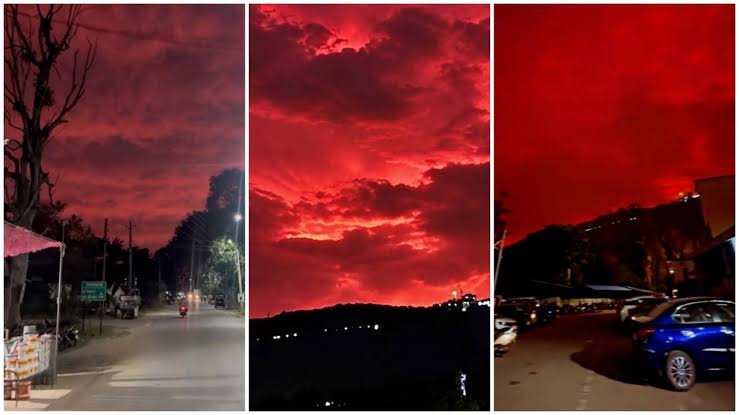
Residents across parts of Chhattisgarh were left stunned as skies turned an apocalyptic, blood-red shade following the inland movement of Cyclone Arnab’s remnants.
The unusual optical display appeared alongside severe weather alerts warning of gusty winds, heavy rainfall, and localized thunderstorms across Chhattisgarh, southern Odisha, and northern Andhra Pradesh.
The Science Behind the Red Sky Phenomenon
While dramatic weather events often spark social media speculation, atmospheric scientists note that striking red or orange skies during major cyclonic systems are usually caused by a combination of atmospheric scattering and dense cloud geometry:
- Rayleigh & Mie Scattering: As sunlight passes through extended storm clouds at low angles, shorter blue and green light waves are filtered out. The longer red and orange wavelengths pass through, intensifying under high atmospheric moisture.
- Aerosols & Suspended Particles: High-altitude cloud bands (cirrus and altostratus) combined with dust, airborne particles, and fine moisture droplets carried inland by cyclonic winds act as a natural filter, deepening the crimson hue.
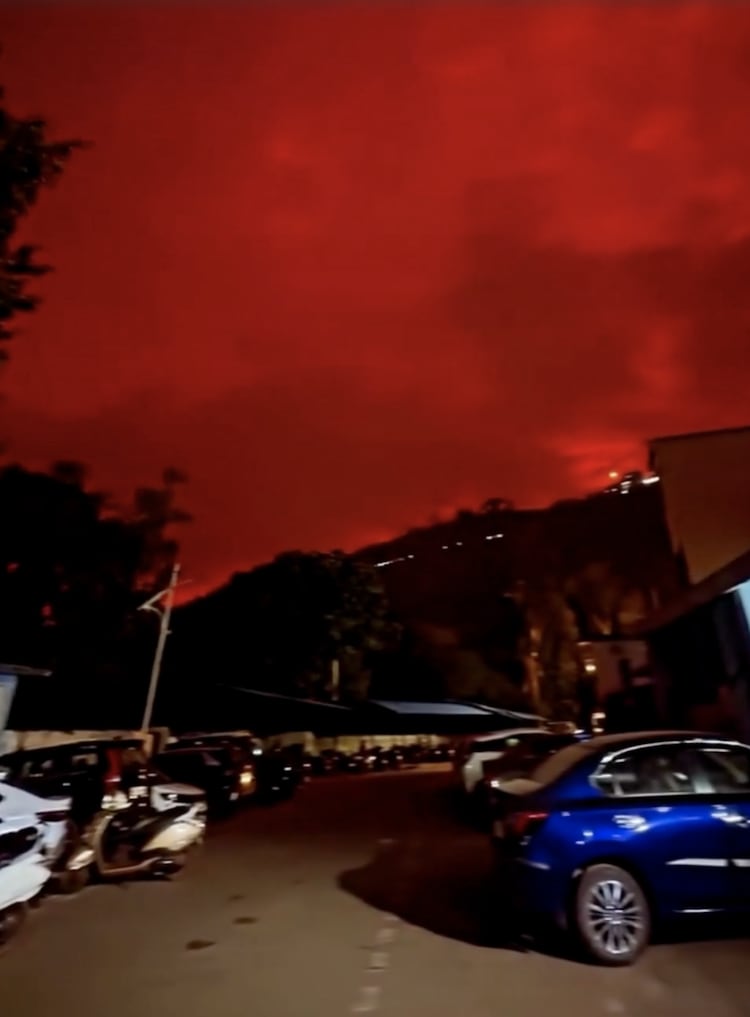
Safety Advisories Remain in Effect
Despite the visual spectacle captured on social media, weather authorities caution that the primary concern remains the threat of severe weather.
The India Meteorological Department (IMD) has advised residents across affected regions to follow official bulletins, stay indoors during active thunderstorms, and exercise extreme caution near waterlogging and weak structures as the system continues to dissipate into a low-pressure area.