Odisha has etched its name in the history books by becoming the first state in India to launch a dedicated protocol for managing Sickle Cell Disease in pregnant women.
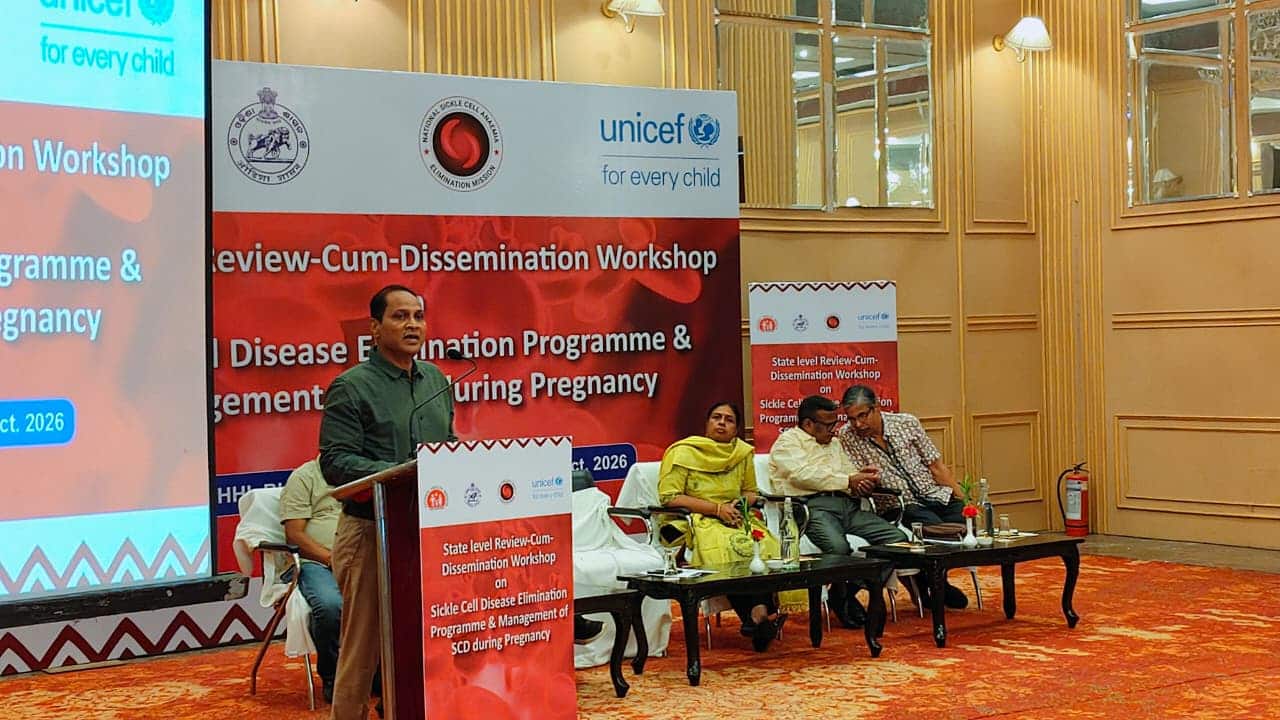
The groundbreaking initiative took centre stage today at a high-level gathering in the capital city. The National Health Mission (NHM) Odisha, the Directorate of Blood Safety, and UNICEF Odisha jointly organised a one-day State-Level Review-Cum-Dissemination Workshop on “Sickle Cell Disease during Pregnancy” at Hotel HHI, Bhubaneswar.
Bringing together key stakeholders—including District Public Health Officers from 21 high-burden districts, medical experts, and development partners like the William J Clinton Foundation (WJCF)—the event marked a decisive push toward strengthening the ongoing Sickle Cell Anaemia Elimination Programme.
A Landmark Step for Maternal Safety
While Odisha has consistently led the nation in screening and detection efforts, health authorities recognised an urgent need to address the compounding risks that Sickle Cell Disease poses during pregnancy. Without timely interventions, affected pregnancies face significantly higher health complications compared to non-affected ones.
To bridge this critical gap, a comprehensive, first-of-its-kind “Protocol for Management of Pregnancy with Sickle Cell Disease” was officially unveiled. Crafted through meticulous collaboration among state medical college experts, NHM program divisions, the Health Directorate, and UNICEF, the new protocol provides clear clinical guidance and outlines specific responsibilities for healthcare providers across all tiers of the healthcare system.
High-Level Leadership and Collaborative Action
The workshop was inaugurated by esteemed health administrators and dignitaries, featuring insights from:
-
Shri. Harish Chandra Nayak, Mission Director (In-charge)
-
Dr Sanjay Kumar Mohapatra, Director, Blood Safety & Public Health
-
Dr Bishnu Prasad Mohapatra, Director, Family Welfare
-
Dr Bijay Kumar Mohapatra, Team Lead, SHSRC
-
Dr Murlidhar Padhi, Additional Director, Maternal Health
-
Dr Meena Som, Health Specialist, UNICEF Odisha
Paving the Way Forward
During the day’s technical sessions, participants evaluated current screening outcomes, mapped out strategies for efficient treatment, follow-ups, and transportation benefits, and received in-depth training on the newly introduced guidelines.
The workshop concluded on a resolute note with the formulation of a unified action plan. This roadmap is designed to ensure the seamless rollout and implementation of the protocol down to the grassroots district level—ultimately safeguarding maternal lives and setting a powerful benchmark for the rest of the country.