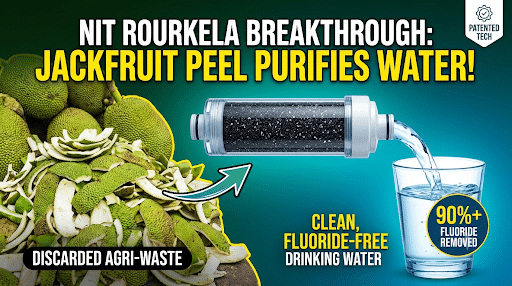
In a major step toward tackling groundwater contamination, chemical engineers at the National Institute of Technology (NIT) Rourkela have developed an eco-friendly material derived from discarded jackfruit peels capable of removing more than 90% of fluoride from drinking water in just 10 minutes.
The innovation—led by Prof. Susmita Mishra and research graduate Dr. Pratima Minz from the Department of Chemical Engineering—converts agricultural waste into a low-cost, high-efficiency water treatment medium. The research team has already secured a official patent for the technology (Application No. 202531080242, dated August 25, 2025).
A Green Solution to a Public Health Threat
Excessive fluoride levels in drinking water remain a persistent hazard across rural and semi-urban India. Chronic exposure leads to dental and skeletal fluorosis, causing crippling bone deformation and painful tooth decay.
While conventional water purification methods like Reverse Osmosis (RO), activated alumina, and ion exchange exist, they carry notable downsides. RO systems generate significant volumes of toxic wastewater while stripping essential minerals from drinking water. Other methods depend on complex chemical operations that make decentralized deployment in resource-limited rural communities difficult.
By leveraging jackfruit peels—a ubiquitous agricultural byproduct—the NIT Rourkela team has created a sustainable alternative that fulfills a dual role: purifying water while recycling local organic waste.
How the Technology Works
The researchers synthesized activated carbon from the discarded peels and modified its surface structure with zirconium to dramatically enhance its ability to adsorb fluoride ions.
Key performance metrics from laboratory testing include:
- High Removal Efficiency: Removes between 90% and 97% of fluoride within 10 to 20 minutes under tested laboratory conditions (fluoride concentrations of 1–5 mg/L).
- Cost-Effective Synthesis: Current production synthesis is estimated at approximately ₹37 per gram, factoring in electricity and processing materials.
- Current Readiness: The innovation currently stands at Technology Readiness Level 4 (TRL 4), confirming solid validation in a laboratory environment.
The Road Ahead
While these early laboratory results are promising, the researchers emphasize that further engineering is needed before the technology reaches village taps or household counters.
The next phase involves constructing physical prototypes, analyzing long-term media durability, evaluating operational costs at scale, and verifying performance in real-world environments. If successfully commercialized, this jackfruit-based material could form the backbone of next-generation, low-cost decentralized water filters tailored for fluoride-affected regions across India.