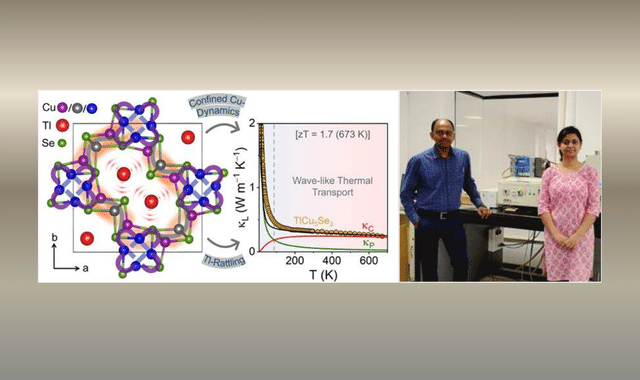
In a major advance for clean energy and industrial sustainability, researchers at the Jawaharlal Nehru Centre for Advanced Scientific Research (JNCASR), Bengaluru, have uncovered an unusual “wave-like” heat transport mechanism in a newly studied material.
The breakthrough could dramatically increase the efficiency of converting industrial waste heat into electricity, turning lost energy into a vital resource for power plants, heavy manufacturing, data centers, and electric vehicle thermal management.
The study, published in Science Advances, investigates a complex copper chalcogenide compound known as thallium copper selenide (\text{TlCu}_5\text{Se}_3). The findings challenge conventional understanding of how heat travels through solid materials and open new pathways for sustainable energy harvesting.
Overcoming the Thermoelectric Paradox
A major challenge in energy recovery is that vast amounts of heat generated in cement plants, steel mills, power generation facilities, and electronic servers escape into the atmosphere. Thermoelectric materials can directly convert this excess thermal energy into electrical power without moving parts. However, creating high-performance thermoelectric materials requires a difficult trick: the material must conduct electricity like a solid metal while blocking heat like a thermal insulator.
Traditionally, heat travels through crystalline solids as particle-like vibrational packets called phonons. In materials with high structural disorder, these phonons collide rapidly, shortening their mean free path and reducing thermal conduction. However, highly disordered or “superionic” materials often become structurally unstable over time as ions migrate too freely, degrading overall performance.
A Cloverleaf Knot That Traps Atomic Motion
To solve this stability problem, the research team—led by Prof. Kanishka Biswas, along with Ph.D. students Ms. Sayantoni Choudhury and Dr. Animesh Bhui from JNCASR’s New Chemistry Unit—focused on a unique crystal architecture.
The material, \text{TlCu}_5\text{Se}_3, crystallizes in a tetragonal structure that forms a complex, three-dimensional cloverleaf knot-like framework with open channels along its crystallographic c-axis.
Instead of allowing copper (\text{Cu}) atoms to wander freely and destabilize the lattice, this tight structural framework keeps the copper ions confined.
- Confined Dynamic Disorder: The restricted, jittery motion of copper atoms creates localized dynamic disorder without ruining the long-range crystal structure.
- Extreme Anharmonicity: This localized motion creates asymmetric atomic vibrations, disrupting typical particle-like phonon propagation.
- Wave-Like Coherence: Instead of heat moving as discrete particles, thermal energy propagates through wave-like coherence—essentially allowing phonons to tunnel between localized vibrational states.
Advanced theoretical calculations and molecular dynamics simulations led by Prof. Umesh V. Waghmare and Dr. Prasad V. Matukumilli from JNCASR’s Theoretical Sciences Unit confirmed that this wave-like tunneling suppresses thermal conduction to ultralow levels while preserving structural stability.
Peak Performance and Real-World Applications
This combination of wave-like thermal suppression and favorable electrical conductivity yields an exceptionally high thermoelectric figure of merit (zT = 1.7) in its pristine state—one of the highest values ever recorded for pristine ternary chalcogenides.
                  +-----------------------------------+
                  |  Complex Crystal Framework        |
                  |  (3D Cloverleaf Knot Channels)    |
                  +-----------------+-----------------+
                                    |
                                    v
                  +-----------------------------------+
                  |  Confined Cu Dynamic Disorder     |
                  +-----------------+-----------------+
                                    |
                                    v
                  +-----------------------------------+
                  |  Wave-Like Phonon Tunneling       |
                  |  (Ultralow Thermal Conductivity)  |
                  +-----------------+-----------------+
                                    |
                                    v
                  +-----------------------------------+
                  | High Thermoelectric Merit zT = 1.7|
                  +-----------------------------------+
The discovery holds transformative potential across several major sectors:
- Heavy Industry & Power Plants: Direct recovery of high-temperature waste heat from steel furnaces, cement kilns, and exhaust systems.
- Data Centers & Computing: Efficient passive cooling and energy reclamation from high-density server racks.
- Automotive & EV Batteries: Advanced thermal management systems that convert excess heat into auxiliary electrical power.
- Quantum Technologies: Material architecture suitable for thermal barrier coatings and decoherence-free quantum devices that require strict thermal control.
By establishing how structural complexity and confined dynamic disorder can trigger unconventional thermal transport, the JNCASR team has provided both a practical material and a foundational design strategy for next-generation clean energy technology.