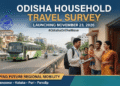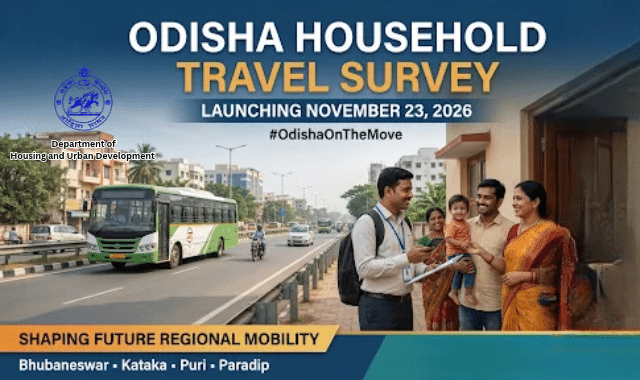
In a major push to overhaul public transit and regional connectivity across Odisha’s fastest-growing urban corridor, the state’s Housing and Urban Development (H&UD) Department is set to launch a sweeping Household Travel Survey starting November 23, 2026.
Rolled out under the banner of the #OdishaOnTheMove initiative, the exercise forms the bedrock of the upcoming Comprehensive Regional Mobility Plan (CRMP) for the Bhubaneswar–Kataka–Puri–Paradip Economic Region (BKPPER). By tapping directly into the daily commuting experiences of residents, the state government aims to design an integrated, affordable, and seamless transport network linking major urban centres with emerging industrial and economic hubs.
Decoding the Daily Commute
For years, rapid urbanisation across the Bhubaneswar-Kataka twin-city belt, the pilgrimage hub of Puri, and the port town of Paradip has strained existing road and transit infrastructure. Rather than relying solely on top-down projections, urban planners are turning to grassroots data to understand how people actually move.
During the survey, researchers will map critical variables of everyday travel:
- Commuting Mechanics: Preferred modes of transport, trip frequency, and average journey durations.
- Economic Impact: Daily commuting expenditure across different income groups.
- Bottlenecks: Existing connectivity gaps, last-mile hurdles, and infrastructural pain points encountered on the road.
Beyond raw numbers, the survey opens a direct feedback channel for citizens to voice suggestions on upgrading public buses, improving road networks, and modernising transit infrastructure.
Leadership Calls for Citizen Partnership
State officials emphasised that the success of the Comprehensive Regional Mobility Plan hinges on robust public participation.
Urging residents to open their doors to the initiative, Dr. Krushna Chandra Mahapatra, Minister for Housing & Urban Development, noted that transit policy directly impacts social and economic mobility. “Mobility is not merely about moving from one place to another; it is about connecting people to opportunities, education, healthcare, livelihoods, and a better quality of life,” Dr Mahapatra said. “Through #OdishaOnTheMove, we are working towards a transport system that is integrated, accessible, affordable, and responsive to the needs of our citizens.”
Echoing the need for empirical policymaking, Usha Padhee, ACS, H&UD Dept, highlighted how real-world data will dictate future infrastructure spending. “A well-designed regional transport network must be informed by how people travel in their everyday lives, the challenges they encounter, and the connectivity they expect,” she explained. “The data gathered through this exercise will provide valuable insights for evidence-based planning, better integration of different modes of transport, and prioritisation of future investments.”
Hybrid Outreach and Data Privacy
To ensure maximum reach across both urban neighbourhoods and peri-urban pockets of the BKPPER belt, the H&UD Department has adopted a hybrid data-collection model. Authorised field enumerators will conduct door-to-door household visits, supplemented by a self-service digital survey accessible via an official QR code issued by the department.
Addressing potential privacy concerns, the department has issued strict assurances that all household data collected will remain completely confidential and be utilised exclusively for transport planning purposes.
The Road Ahead
Envisaged as a long-term strategic blueprint, the CRMP aims to balance regional growth by synchronising multi-modal transport—ensuring that buses, railways, and road networks complement rather than compete with one another.
With the campaign rallying around the message that “Every Journey Matters. Every Voice Counts,” the H&UD Department has appealed to all BKPPER residents to cooperate with enumerators and log their feedback online, giving everyday commuters a direct hand in steering Odisha’s transit future.