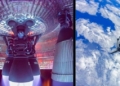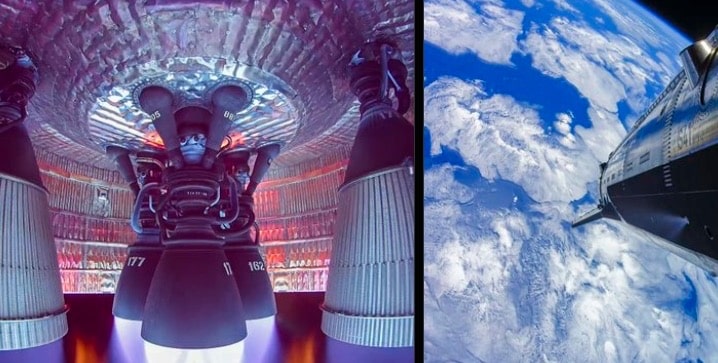
Starship crossed a threshold that thirteen earlier flights never reached. On September 28, 2026, the vehicle lifted off from Starbase, Texas, entered low Earth orbit for the first time, and released 26 operational Starlink V3 satellites that remained in space and established contact. Days later, SpaceX highlighted the result with images of the deployment sequence and the ship coasting above Earth.
The flight, designated Flight 14, used Super Heavy booster B21 and Ship 41. Liftoff occurred at 7:48 a.m. Central Time. All 33 Raptor engines on the booster ignited; one shut down during the climb, yet the stage completed a controlled splashdown in the Gulf of Mexico. After hot staging, the ship lit its six Raptors. One vacuum-optimized engine cut off early. The remaining engines burned longer to keep the vehicle on a safe trajectory. Controllers assessed the systems, cleared an orbital-insertion burn on a single sea-level Raptor, and placed Ship 41 into an orbit of roughly 262–275 kilometers about 25 minutes after launch.
Roughly nine minutes later, the payload bay door opened. Over the next half hour, Starship pushed the 26 flat-packed Starlink V3 satellites out one by one. SpaceX later confirmed contact with every satellite via laser links, ground stations, or user terminals. Three of the satellites carried cameras aimed back at the ship to inspect heat-shield tiles. Elon Musk noted that all 26 were operating nominally. These V3 spacecraft deliver roughly ten times the downlink capacity and more than twenty times the uplink capacity of earlier Starlink versions, with each satellite designed for about 1 terabit per second of downlink. They are too large for Falcon 9; future Starship flights are expected to carry up to 60 of them.
The mission did not run its full plan. A six-orbit, nearly ten-hour flight was shortened after the engine anomaly. Ship 41 performed its first deorbit burn, survived reentry, and splashed down in the northern Pacific about three hours and eight minutes after liftoff. Residual propellant caused it to tip and break up after water contact, consistent with prior expendable test endings. No tower catch was attempted for either stage.
The flight still delivered the program’s clearest operational proof yet. Thirteen prior tests had stopped short of a sustained orbit and had never left lasting commercial payload behind. Flight 14 did both, even with an engine out. The images SpaceX released—satellites drifting free against Earth’s limb, the ship’s tiled flank in sunlight, and the engine bay—show the hardware functioning in the environment it was built for. For Starlink, the result opens a path to much larger capacity additions per launch. For Starship, it marks the shift from pure flight testing toward routine payload delivery.