
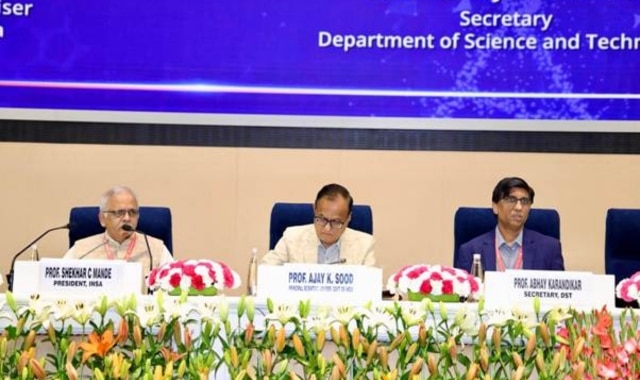
Principal Scientific Adviser Prof. Ajay K. Sood chaired the lectures, stressing that India’s scientific progress must converge with policy direction. He highlighted sectors such as aerospace, defence, critical metals, advanced materials, and digital communication as requiring coordinated institutional mechanisms and sustained investment. He underscored that science–policy synergy is vital for translating research into national strength.
Prof. Abhay Karandikar, Secretary of the Department of Science and Technology, reinforced the need for translational innovation. He noted that India’s science policy must support both frontier research and practical deployment, ensuring that laboratory outcomes reach society efficiently. He also emphasised empowering women in science and building inclusive ecosystems.
Prof. Shekhar C. Mande, President of the Indian National Science Academy, called for sustained dialogue between scientists and policymakers. He stressed that evidence-based policymaking must rely on scientific expertise and institutional collaboration.
The lectures featured presentations on Made in India aerospace technologies, critical metals solutions, and direct-to-mobile broadcasting. Dr. Shubha V. Iyenger highlighted “Drishti,” India’s first indigenous runway visibility system, for which she received the Padma Shri in 2026.
The event concluded with a collective resolve to deepen science–policy integration, strengthen institutional collaboration, and enhance public engagement with science to catalyse India’s long-term development goals.