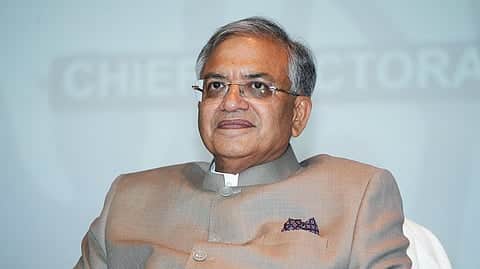
The Supreme Court issued a notice to the Election Commission of India (ECI) and the Centre, seeking responses within a week regarding allegations that Chief Election Commissioner (CEC) Gyanesh Kumar took key administrative decisions unilaterally without the statutory consensus of the two other Election Commissioners.
However, a bench led by Chief Justice of India (CJI) Surya Kant, alongside Justices Joymalya Bagchi and V. Mohana, declined to pass an interim order suspending the CEC or divesting him of his duties pending the hearing.
Court Warns Unilateral Orders May Be Recalled
Addressing a petition filed by Patna resident Rakesh Kumar Singh, the apex court indicated that it holds the power to undo actions if the poll panel failed to adhere to consensus-based governance.
“After notice, if they come and show that decisions were taken without unanimity, we will take those decisions back,” the CJI remarked.
The petition called for stripping CEC Gyanesh Kumar of his operational powers until the final disposal of the case, proposing instead that daily business be conducted exclusively through the unanimous agreement of Election Commissioners Sukhbir Singh Sandhu and Vivek Joshi.
| Key Aspects of the Legal Challenge | Details |
| Petitioner | Rakesh Kumar Singh (Patna resident) |
| Primary Allegation | Over 14 decisions executed without approval of fellow Commissioners |
| Key Relief Sought | Suspension of CEC, business via unanimous vote of ECs Sandhu & Joshi |
| SC Bench | CJI Surya Kant, Justice Joymalya Bagchi, Justice V. Mohana |
| Immediate SC Ruling | Notice issued (1-week deadline); no interim suspension order granted |
Internal Objections Triggered Legal Battle
The legal challenge follows reports revealing that Election Commissioners Sukhbir Singh Sandhu and Vivek Joshi logged at least 14 formal objections between October 2025 and August 2026. The objections centred around actions taken under the Special Intensive Revision (SIR) of electoral rolls, which were allegedly authorised without full panel deliberations.
Senior Advocate Menaka Guruswamy, appearing for the petitioner, highlighted severe irregularities in how the SIR was conducted in Delhi. She pointed out that new conditions were added to voter registration procedures, stating that even legal professionals received notices under the altered framework.
“Now there’s another election cycle. CEC’s functioning is biased, to say the least!” Guruswamy argued.
‘We Didn’t Approve Modified Form 6’: CJI Clarifies
During the proceedings, the bench directly addressed claims regarding alterations made to Form 6—the statutory form used by first-time voters for inclusion in the electoral roll.
Clearing the air, CJI Surya Kant stated:
“Any modified Form 6 has not been approved by us. Let’s be clear. When the record is produced, we would like to see who has modified it.”
While noting that the prayers in the petition appeared broad and “jumbled up,” the CJI reiterated that multi-member bodies like the Election Commission must function either by absolute consensus or majority vote under statutory mandate. The court tagged the petition with related matters challenging the ECI’s recent administrative actions and scheduled further hearings following the responses from the ECI and the Centre.