A fresh clarification from India’s Ministry of External Affairs (MEA) has triggered a nationwide discussion on a crucial question: What actually proves Indian citizenship?
The debate gained momentum after officials stated that an Indian passport, despite being one of the most trusted government-issued documents, should not be considered conclusive proof of citizenship. The statement has drawn attention amid ongoing discussions around electoral roll revisions, citizenship verification exercises, and identity documentation.
Why Has the MEA’s Statement Created a Debate?
An Indian passport allows citizens to travel internationally, seek consular assistance abroad, and establish nationality before immigration authorities worldwide. Naturally, many people assume it serves as definitive proof of citizenship.
However, the MEA’s clarification suggests a distinction between a passport being strong evidence of citizenship and being absolute legal proof of citizenship in every circumstance.
This has raised an important question: If a passport is not conclusive proof, what document is?
What Does Indian Law Say About Passports?
The Passports Act, 1967, allows passports to be issued only after authorities verify an applicant’s eligibility and citizenship status.
Under the law:
- Authorities can refuse a passport if the applicant is not an Indian citizen.
- Applications undergo verification and scrutiny before approval.
- Passports can later be revoked if citizenship claims are found to be incorrect or obtained through misrepresentation.
Legal experts note that while a passport is strong evidence that the government has accepted a person’s citizenship claim, it may not always be treated as the final authority if disputes arise.
Is a Voter ID Card Proof of Citizenship?
Not exactly.
A voter ID card confirms that a person is registered as an elector. Since only Indian citizens can vote, it indicates that election authorities considered the individual eligible.
However, courts and election authorities may still review a person’s eligibility if questions regarding citizenship emerge. Therefore, a voter ID card alone is generally not considered definitive proof of citizenship.
Which Documents Can Establish Citizenship?
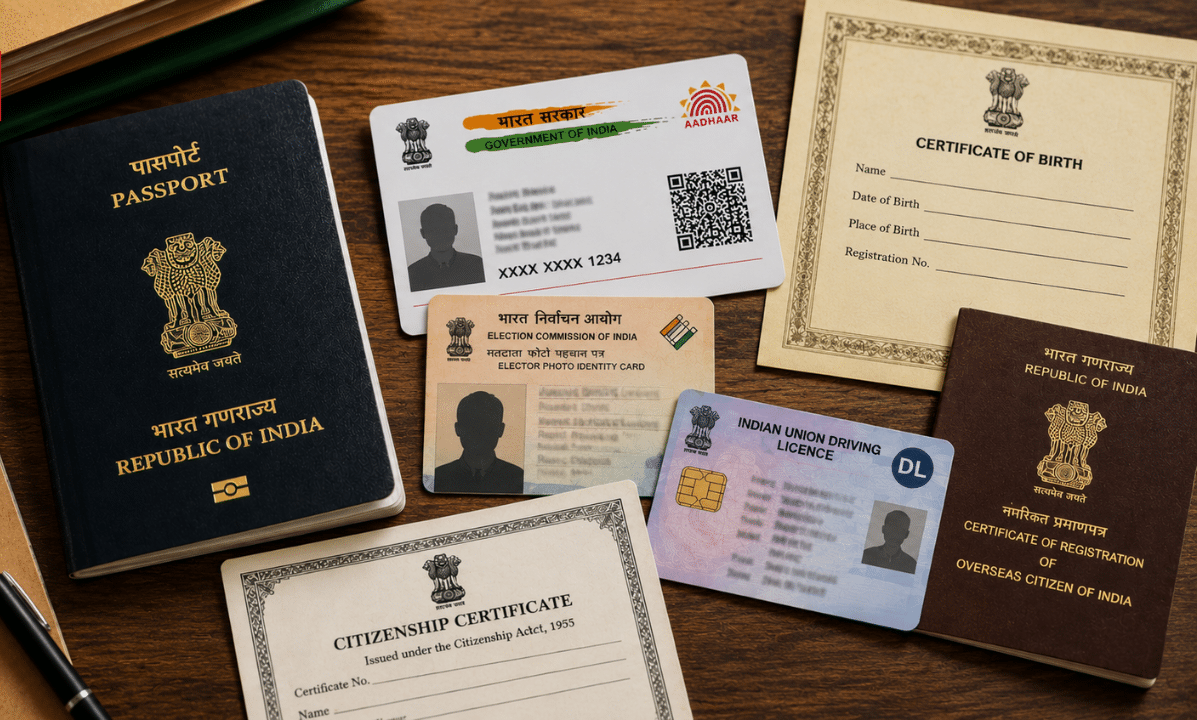
India does not issue a universal citizenship certificate to every citizen at birth. Instead, citizenship is often established through a combination of records and documents.
These may include:
- Birth certificates
- Passports
- Citizenship certificates
- Parental records
- School records
- Electoral documents
- Residence-related documents
The relevance of each document depends on how an individual acquired citizenship—whether by birth, descent, registration, naturalisation, or incorporation of territory.
What About Aadhaar and PAN Cards?
Aadhaar is not proof of citizenship.
The Aadhaar Act clearly states that Aadhaar is issued to residents and not exclusively to Indian citizens.
Similarly:
- PAN cards are tax identification documents.
- Ration cards are welfare-related documents.
- Aadhaar establishes identity and residence but not citizenship.
Is There Any Single Citizenship Document in India?
For most Indians, the answer is no.
India does not have a national citizenship card.
The only document specifically certifying citizenship is a Citizenship Certificate issued under the Citizenship Act, 1955. However, such certificates are typically issued to people who acquire citizenship through registration or naturalisation, not to citizens by birth.
Why This Matters
The controversy highlights a unique feature of India’s legal system. Citizenship is generally presumed unless challenged, and authorities often rely on multiple records rather than a single document.
As citizenship verification exercises become more common, many people are asking whether India should adopt a more uniform system for establishing citizenship status.
The MEA’s clarification may have been intended as a legal distinction, but it has reopened a broader conversation about identity, documentation, and citizenship rights in the world’s largest democracy.
For now, legal experts say citizenship determination in India continues to depend on a combination of documents, official records, and the specific circumstances of each case.